

On January 15, 2027, every candidate on Nevada's November 3, 2026 ballot owes the Secretary of State a report covering the final quarter of the campaign, and it is the only report that will show what was raised and spent in the closing weeks of the race. The rules behind that report sit in NRS Chapter 294A. Willful violations of the contribution limits are felonies, a late report accrues a daily penalty from the first day, and a political advertisement that omits the payer's name violates the chapter. This guide covers what a campaign finance lawyer at Hutchison & Steffen reviews with candidates, committees, and treasurers at this point in the cycle.
If your campaign or committee has a compliance question that cannot wait, call Hutchison & Steffen at 702.385.2500 in Las Vegas or 775.853.8746 in Reno, or schedule a consultation with the Firm's election law attorneys.
Who Nevada's Campaign Finance Rules Cover
Nevada campaign finance law, NRS Chapter 294A, applies to candidates for state, district, county, township, city, and judicial office in Nevada, and to the committees for political action, political parties, and independent spenders (people or groups that spend on a race without coordinating with a candidate) that raise or spend money to influence those races. Candidates for federal office are the exception: federal law governs their campaigns, and NRS 294A.100 excludes federal office from the state contribution limit.
The statutory definition of a candidate is broader than the word suggests. Under NRS 294A.005, a person becomes a candidate by filing a declaration of candidacy, by appearing on an official ballot, or by receiving one or more contributions of more than $100, whether or not a declaration has been filed. An exploratory effort that accepts a $250 check has a candidate, and the reporting obligations that come with candidacy, from that day. A contribution, under NRS 294A.007, is any gift, loan, conveyance, deposit, payment, transfer, or distribution of money or anything of value other than a volunteer's services, and it includes in-kind items such as paid polling, paid direct mail, paid phone solicitation, printed paraphernalia, and the loan of paid staff.
Committees are defined by purpose and by dollar thresholds. Under NRS 294A.0055, a group that solicits contributions and makes contributions or expenditures to affect an election is a committee for political action from its first dollar. An organization whose primary purpose is affecting elections becomes one once it receives or spends more than $1,500 in a calendar year; an organization without that primary purpose becomes one at $5,000 in contributions or independent expenditures.
Since October 1, 2025, individual natural persons, corporations and business organizations formed under Title 7, labor unions, political parties, and nonprofits are categorically outside the committee definition, but a 2025 amendment to NRS 294A.210 requires a corporation, business organization, nonprofit, or labor union that spends more than $1,000 to affect a Nevada election to file expenditure reports anyway.
Nevada's Contribution Limits Under NRS 294A.100
A person may give a Nevada candidate no more than $5,000 for the primary election and $5,000 for the general election, regardless of the number of candidates running for the office. The limit originates in Article 2, Section 10 of the Nevada Constitution and is implemented by NRS 294A.100, which measures the period for state, district, county, and township offices from January 1 of the year after the last general election for that office through December 31 after the next one. City offices run on a separate window keyed to the city election calendar. A candidate may not accept a contribution that exceeds the limit, and a willful violation by either side is a category E felony, the lowest felony class in Nevada.
Person is defined expansively. NRS 294A.009 reaches natural persons, corporations, partnerships, associations, trusts, unions, committees for political action, and political parties, so a committee that writes a candidate a check is bound by the same $5,000 figures as an individual donor. The statute contains no exception for a candidate who draws no primary opponent; it states the primary and general limits separately and says nothing about an uncontested primary. Treasurers who assume a second $5,000 is available because the primary was uncontested should confirm the treatment with a campaign finance attorney or the Secretary of State before depositing the check.
Three companion rules close the obvious workarounds. NRS 294A.112 prohibits contributions in the name of another, including a reimbursed contribution, the knowing acceptance of one, and a contribution routed through a committee with the intent that it reach a specific candidate in excess of the limit. NRS 294A.325 bars any foreign national, as defined in federal law, from contributing to a candidate, committee, party, or independent spender, and bars recipients from knowingly accepting such a contribution.
A campaign has a safe harbor if it obtains a copy of the contributor's current United States passport; money discovered to be foreign must be returned within 30 days, and a violation is a gross misdemeanor, a criminal offense below a felony. NRS 294A.190 also requires a candidate who receives $100 or more from an anonymous or unidentifiable source to deliver the money to the State Treasurer or donate it to a nonprofit within 10 days.

When Nevada Contribution and Expense Reports Are Due
Nevada candidates file five contribution and expense reports across an election year, and none of them falls immediately before an election. Under NRS 294A.120 and NRS 294A.200, the reports are due January 15 of the election year for the prior calendar year, then April 15, July 15, and October 15 for the three calendar quarters that precede them, and finally January 15 of the following year for the period from October 1 through December 31. A report is deemed filed on the day the Secretary of State receives it.
For the 2026 cycle, the Secretary of State's calendar confirms the dates: the third report, covering July 1 through September 30, was due October 15, 2026, and the fourth report, covering October 1 through December 31, 2026, is due January 15, 2027, alongside the annual filing for the year. The filing window for that report opens January 1, 2027. Nothing is due in November 2026, which differs from the federal pre-election schedule.
The result is that every dollar raised and spent in the final weeks before November 3 lands in a single public report filed after the results are known. The four-days-before and 30-days-after deadlines that appear in the chapter apply only to special and recall elections.
After the election, the filing obligation continues for winners. NRS 294A.120 requires an elected candidate to report each January 15 for the preceding calendar year until the year before the next election for the office, and NRS 294A.125 requires any candidate who collects more than $10,000 in an off year to report annually as well. All of it is filed electronically through the Secretary of State's online disclosure system, which the office calls AURORA.
Paper filing survives only for a candidate who raises and spends less than $10,000 and files a sworn affidavit under NRS 294A.3733 attesting to a lack of access to the technology and the means to obtain it. County, city, and judicial candidates file with the Secretary of State too; the chapter gives county and city clerks no role in receiving these reports.
Political campaign mailing processed through the United States Postal Service requiring paid-for-by disclosure under Nevada law
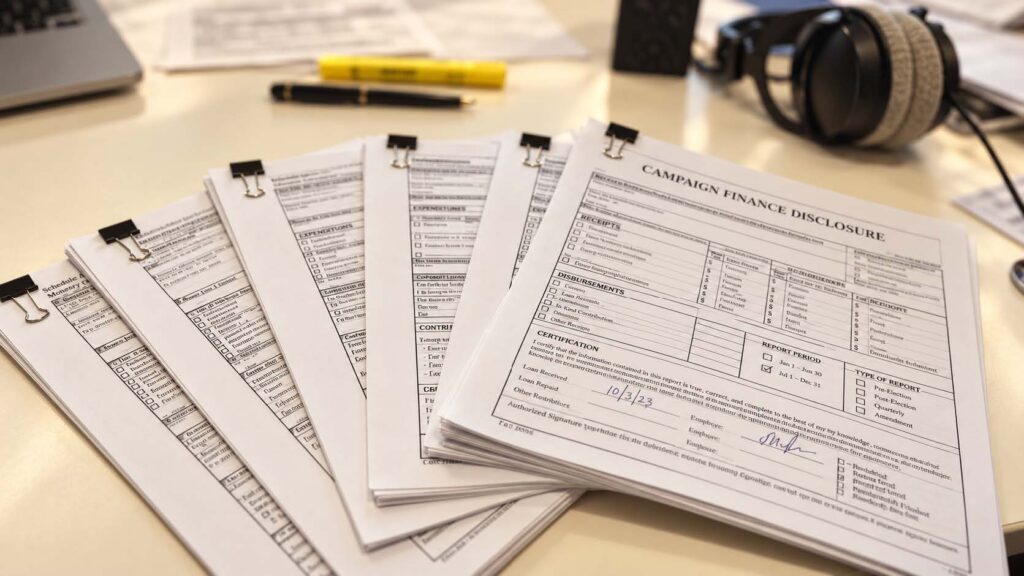
A candidate's contribution report must itemize every contribution of more than $100 and every contributor whose contributions cumulatively exceed $100 since the beginning of the current reporting period, with the contributor's name and address and the date of receipt, together with the total of all contributions of $100 or less and the balance in the campaign account. The aggregation resets each reporting period rather than running for the whole cycle, a detail to check if the campaign tracks donors on a cycle basis.
Expense reports follow the same threshold. Each campaign expense of more than $100 is listed under one of the categories set out in NRS 294A.365, which include office expenses, volunteer expenses, travel, advertising, paid staff, consultants, polling, special events, legal defense, personal security, in-kind expenses, contributions to other candidates or committees, filing fees, loan repayment, and the disposal of unspent funds. A credit or debit card transaction cannot be reported as a single line to the card issuer; it must be itemized by vendor. In-kind contributions go on a separate form under NRS 294A.362, and NAC 294A.043 requires a signed statement from the contributor, within 30 days, giving the actual cost or, if that cannot be determined, the fair market value.
Committees, parties, and independent spenders report on the same five dates but at a different threshold. Under NRS 294A.140 and NRS 294A.210, they itemize contributions and expenditures of more than $1,000, including cumulative amounts from a single contributor or to a single payee, and they must file even in a period with no activity. The report is signed under penalty of perjury whether it is filed on paper or online.
Registering a Committee for Political Action in Nevada
A committee for political action must register with the Secretary of State before it engages in any activity in Nevada, and NRS 294A.230 treats each activity by an unregistered committee as a separate violation. An organization that becomes a committee by crossing the $1,500 or $5,000 threshold has seven calendar days after the qualifying event to register. Registrations must be amended within 30 days of any change and renewed on or before January 15 of each year, and NRS 294A.240 requires every committee to maintain a registered agent in the State.
The money has to be segregated early. NRS 294A.130 requires a separate account once aggregate contributions reach $1,000, with the account opened within one week after that point. A 2025 amendment added NRS 294A.245, which lists what a committee may do with the money in that account, including contributing to candidates subject to the $5,000 limits. Committees formed to support or oppose a ballot question register and report on the same schedule under the chapter's ballot-question provisions.
Disclosures on Political Advertising, Including the 2026 Synthetic Media Rule
Any person, committee, or party that spends more than $100 on a communication that expressly advocates the election or defeat of a clearly identified candidate (urges a vote for or against a named candidate), or that solicits contributions, must disclose on the communication the name of the person, committee, or party that paid for it. That is the rule in NRS 294A.348, and it reaches television, radio, print, outdoor advertising, mailers, and any other general public political advertising. The statute does not prescribe the words "paid for by." What it requires is the payer's name, stated clearly and conspicuously.
A communication approved by a candidate carries more. It must state that the candidate approved it and disclose the street address, telephone number, and Internet address of the person or committee that paid for it. Text messages that cost more than $100 must carry the payer's name, and so must a public website or an electronic mailing sent to more than 500 people.
NRS 294A.349 exempts clothing and items that retail for less than $5, such as buttons and pens, but the exemption does not extend to door hangers, bumper stickers, or yard signs. Two older rules sit alongside: NRS 294A.330 permits the word "reelect" only for a candidate elected to the identical office and serving continuously, and NRS 294A.340 bars any implication of incumbency by a challenger.
The newest requirement took effect January 1, 2026. NRS 294A.3493, added by Assembly Bill 73 of the 2025 session, requires any covered communication that includes synthetic media to state that the image, video, or audio has been manipulated. A video must carry the disclosure for its entire duration, and an audio spot must read it at the beginning, at the end, and every two minutes in between. A candidate depicted in undisclosed synthetic media may seek an injunction in district court. Nevada's rule is disclosure, not prohibition, and it applies to a campaign's own creative as much as to an opponent's.

Spending Campaign Money and Closing Out the Account
A Nevada candidate or public officer may not spend campaign contributions for personal use or to pay himself or herself a salary. NRS 294A.160 states the prohibition, and NRS 294A.011 defines personal use as an expense that would exist irrespective of the campaign. Legal expenses may be paid from contributions without creating a separate legal defense fund, but a civil or criminal penalty may not be. A November 2025 amendment adopted in the 36th Special Session added personal security incurred in direct connection with the campaign as a recognized expense category and excluded it from the definition of personal use.
What happens to unspent money depends on how the campaign ended. An elected candidate may return it to contributors, hold it for the next election or for expenses related to public office, contribute it to other candidates or a political party, or donate it to a tax-exempt nonprofit or a governmental entity. A candidate who withdraws or is removed from the ballot must dispose of unspent funds by the 15th day of the second month after the election, and contributions that exceeded $5,000 from a single person must be returned on the same timetable when a candidate withdraws or loses the primary.
The 2025 session rewrote the rules for the two remaining groups. A defeated candidate may hold the money for a future race but must dispose of it if four years pass without a new declaration of candidacy or a ballot appearance. A former public officer must dispose of unspent contributions within 15 days after the four-year period that follows leaving office, and officers holding funds under the old rules on October 1, 2025, have until October 1, 2029 to comply.
Penalties and How the Secretary of State Enforces NRS 294A
A violation of NRS Chapter 294A exposes the candidate, committee, or party to a civil penalty of up to $10,000 for each violation, plus court costs and attorney's fees, recovered by the Secretary of State in an action filed in the First Judicial District Court in Carson City. For late reports, NRS 294A.420 fixes the amount by formula: $25 for each day the report is late for the first seven days, $50 per day from the eighth day through the 15th, and $100 per day after that. An uncompensated public officer, or a candidate for such an office, who had no contributions and no expenditures faces a total of no more than $100. Criminal exposure runs separately, with a category E felony for a willful contribution-limit violation and a gross misdemeanor for accepting a foreign national's money.
A campaign finance lawyer's first move after a penalty notice is usually a waiver request. The Secretary of State may waive a civil penalty for good cause, weighing the seriousness of the violation, the filer's history, any mitigation, whether the lapse was inadvertent, and the filer's knowledge and experience. The office's regulations foreclose one argument: under NAC 294A.097, a penalty will not be waived or reduced merely because the filer did not receive a reminder that a report was due. Enforcement begins under NRS 294A.410 with a signed complaint or with the Secretary of State's own reasonable suspicion, which is the point at which an election lawyer should be involved, and the office may investigate and prosecute the matter itself or refer it to the Attorney General. Its subpoena power is available only when a complaint arrives within 180 days after the election in question. NRS 294A provides no administrative hearing process; the First Judicial District Court is the forum.
How Hutchison & Steffen Advises Nevada Candidates and Committees
Hutchison & Steffen is a full-service, AV-rated Nevada law firm with more than 60 attorneys and three decades of practice in the State. The political law attorneys in the Firm's Election, Campaign, & Political Law practice advise candidates, committees for political action, political parties, and public officials on candidate filing and committee formation, campaign finance reporting and compliance, representation before the Secretary of State, ballot access and petition challenges, election contests and recounts, and redistricting litigation.
The practice includes Mark A. Hutchison, who served as Nevada's 34th Lieutenant Governor following his service as a State Senator, and before that as a member and Chairman of the Nevada Ethics Commission. He was lead trial counsel in Guy v. Miller (2011), the litigation over the constitutionality of Nevada's congressional and legislative boundaries, and his broader practice includes constitutional and appellate litigation. His article on the why, what, and when of running for political office is a starting point for a prospective candidate, and the Firm's guidance on what to do when a letter arrives from a government agency applies directly to a deficiency notice from the Secretary of State. Where a campaign matter raises constitutional questions, the Firm's Constitutional Law and Administrative & Regulatory Law practices work alongside the election practice. Prior results do not guarantee a similar outcome.

Frequently Asked Questions About Nevada Campaign Finance Law
What Are the Campaign Contribution Limits in Nevada?
Under NRS 294A.100, a person may contribute up to $5,000 to a candidate for the primary election and up to $5,000 for the general election, regardless of how many candidates are running. The limit applies to individuals, businesses, unions, committees for political action, and political parties alike, and it does not apply to candidates for federal office. A willful violation is a category E felony.
When Are Nevada Campaign Finance Reports Due After a General Election?
The report covering October 1 through December 31, 2026 is due January 15, 2027, and the annual filing for 2026 is due the same day. Nevada has no report due in the days immediately before or after a general election; the schedule under NRS 294A.120 runs on January 15, April 15, July 15, October 15, and January 15 of the following year. Elected candidates continue to file each January 15 until the year before their next election.
Does a Nevada Political Ad Have to Say Who Paid for It?
Yes. NRS 294A.348 requires any communication costing more than $100 that expressly advocates for or against a clearly identified candidate, or that solicits contributions, to disclose the name of the person or committee that paid for it. A communication approved by a candidate must also state that the candidate approved it and include the payer's street address, telephone number, and Internet address. Yard signs, bumper stickers, and door hangers are not exempt.
Can a Nevada Candidate Keep Leftover Campaign Money?
A candidate may not use leftover contributions for personal use or as a salary under NRS 294A.160. An elected candidate may hold the funds for a future election, return them to contributors, give them to other candidates or a party, or donate them to a nonprofit or governmental entity. A defeated candidate may hold the money for a future race but must dispose of it if four years pass without filing a new declaration of candidacy or appearing on a ballot.
What Is the Penalty for Filing a Late Campaign Finance Report in Nevada?
NRS 294A.420 sets the penalty at $25 per day for the first seven days a report is late, $50 per day from the eighth through the 15th day, and $100 per day after that, in addition to a civil penalty of up to $10,000 for other violations of the chapter. The Secretary of State may waive a penalty for good cause, but not merely because the filer did not receive a reminder. Penalties are recovered in the First Judicial District Court in Carson City.
Contact Hutchison & Steffen About Nevada Campaign Finance Compliance
Candidates, treasurers, and committee officers who need a campaign finance lawyer to review the books before the January 15, 2027 report, or who have received an inquiry from the Secretary of State, can reach the Firm's election law attorneys in Las Vegas, Henderson, Summerlin, North Las Vegas, Reno, Sparks, Carson City, and statewide Nevada.
Las Vegas: 702.385.2500 | Reno: 775.853.8746 | hutchlegal.com/contact
Las Vegas: Peccole Professional Park, 10080 W. Alta Drive, Suite 200, Las Vegas, NV 89145. Reno: 100 W. Liberty Street, Suite 765, Reno, NV 89501.
This post is for general informational purposes only and does not constitute legal advice. It takes no position on any candidate, party, or ballot question. Campaign finance obligations depend on the office sought, the entity involved, and the facts, and the statutes and regulations discussed here are subject to amendment. Reading this post does not create an attorney-client relationship, and prior results do not guarantee a similar outcome. Consult a qualified Nevada attorney about your situation.