


Administrative appeals serve as a vital mechanism for individuals and organizations seeking to challenge decisions made by government agencies. These appeals provide a structured process to contest unfavorable outcomes, ensuring that rights are protected and due process is followed. In this guide, we will explore the concept of administrative appeals, their legal purpose, and the steps involved in filing an appeal. Additionally, we will discuss common grounds for appeal and how Hutchison & Steffen can assist you in navigating this complex process.
Administrative appeals are formal requests to review and overturn decisions made by government agencies. They are essential for ensuring accountability and transparency in administrative processes. By allowing individuals to contest decisions, administrative appeals help maintain the integrity of government actions and provide a pathway for redress. The process typically involves exhausting all available remedies within the agency before escalating the matter to an external tribunal or court.
Indeed, administrative appeals are recognized as a crucial tool for effective adjudication and conflict resolution, ensuring that public and private legal interests are balanced.
Effective Adjudication & Conflict Resolution via Administrative Appeals
“The administrative relations of individuals towards the authority are the framework for balancing public and private legal interests in contemporary societies. Especially when there is a dispute, the system promotes the effective adjudication of contradictory legal interests in order to prove that the authority functions as a good administration. Namely, effective adjudication through administrative appeals can be the primary tool for resolving conflicts as quickly as possible but with full respect for the rule of law and the division of power as key principles of central European legal systems.”
Administrative appeal as a legal process: meaning and role, AB Smanova, 2023

An administrative appeal is a legal procedure that allows individuals to challenge decisions made by government agencies. The primary purpose of these appeals is to ensure that decisions are made fairly and in accordance with the law. For instance, if a government agency denies a permit or benefits, the affected party can file an appeal to seek a review of that decision. This process not only provides a mechanism for individuals to assert their rights but also serves to hold agencies accountable for their actions.
Further emphasizing the foundational role of administrative appeals, research highlights their significance as a legal process that builds public confidence in government actions.
Administrative Appeal: Legal Process, Mechanisms & Public Confidence
“The article explores the importance of social legal awareness development, as well as the provision of Constitutional Law and Administrative Law mechanisms of the right to human rights and freedoms defense. The purpose of the article is the essential role of the administrative complaint concept in society. It analyses legal support process, the subject and the importance of the complaint procedure, when considering appeals by the current State Bodies. The introduction of the administrative appeal procedure in order to increase public confidence in public authorities, including Law Enforcement Agencies in present time, and determine the importance of the administrative complaint process as a process. Ensuring the study of the essential role of Administrative Appeal Law as a process. This article seeks to examine both the mechanisms and procedures of administrative appeal as well as its effectiveness and impact on legal systems.”
Administrative appeal as a legal process: meaning and role, AB Smanova, 2023

Filing an administrative appeal involves several key steps that must be followed to ensure a successful outcome. It is essential to understand the process thoroughly to avoid pitfalls that could jeopardize your appeal.
The administrative appeal process generally includes the following steps:
Following these steps carefully can significantly enhance the chances of a successful appeal.
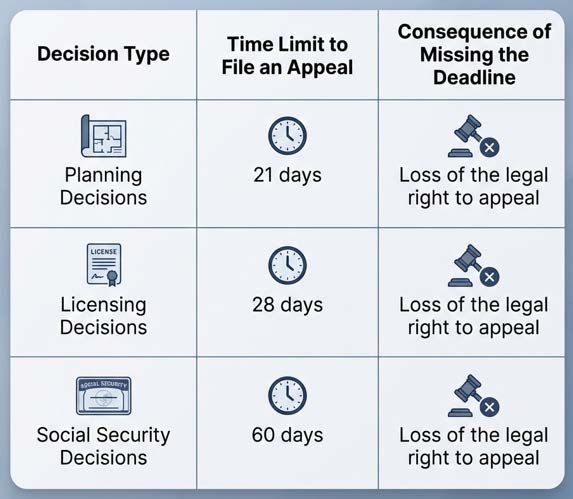
Time limits for filing administrative appeals vary depending on the type of decision being contested and the relevant legislation or tribunal rules. Generally, individuals must file their appeals within a specified timeframe, usually ranging from 21 to 60 days from the date of the decision. Missing these deadlines can result in the loss of the right to appeal, making it crucial to be aware of and adhere to these timelines.
When filing an administrative appeal, it is important to identify valid grounds for contesting the agency's decision. Common grounds for appeal include procedural errors, misinterpretation of the law, and lack of evidence to support the decision.
Legal grounds for an administrative appeal may include:
Establishing valid grounds for appeal is critical to the success of the process.

While both administrative appeals and judicial reviews seek to challenge decisions, they differ in scope and process. Administrative appeals focus on the merits of the decision and whether it was made correctly, while judicial reviews examine whether the decision-making process was lawful and fair. Understanding these differences is essential for individuals navigating the appeals process.
The distinction between these two legal avenues is further elaborated by scholarly work, which clarifies their respective roles in challenging agency decisions.
Administrative Appeal vs. Judicial Review: Purpose & Protection
“In administrative law, there are two major ways of contesting allegedly unlawful decisions/acts: the administrative appeal and the judicial review (court action). While the administrative appeal is an attempt to solve the dispute at administrative level, the judicial review is an adversarial proceeding by which an individual transfers the conflict with a public authority to the (administrative) courts. In principle, the administrative appeal and the judicial review are independent, and the rules for their exercise normally do not interfere with one another.One of the forms of legal protection of a person in relations with public administration authorities is the institution of administrative appeal, the purpose of which is to fully and timely prevent and eliminate any violations of law and discipline in the activities of public authority.”
Administrative Appeal as an out-of-Court Procedure for the Protection of the Rights of Individuals and Legal Entities, I Yuriichuk, 2019

We offer a range of services related to administrative appeals, including:
Our expertise ensures that you have the best possible chance of a successful outcome in your appeal.
The costs associated with administrative appeals can vary based on the complexity of the case and the services required. Typically, clients can expect to incur fees for legal consultations, document preparation, and representation. It is advisable to discuss potential costs upfront to ensure transparency and avoid unexpected expenses.
In summary, understanding the administrative appeal process is crucial for anyone looking to challenge agency decisions effectively. With the right guidance and support from Hutch Legal, you can navigate this complex landscape with confidence.
This post is for general informational purposes and does not constitute legal advice. If you have questions about how a federal agency action affects your business, licensing, project, employment practices, or compliance obligations, consult counsel about your specific circumstances.