
Most Nevada nonprofits are started by people who are good at the mission and new to the paperwork. That is fine until the first grant application that asks for a determination letter, the first board dispute over who controls the money, or the first letter from the Secretary of State or the IRS. A nonprofit attorney’s job is to keep the legal structure ahead of the mission’s growth so none of those moments turns into a crisis.
This guide covers how a nonprofit is formed under Nevada law, what it takes to obtain and keep tax-exempt status, the annual compliance obligations that trip up Nevada organizations, and the legal duties that come with a board seat. Hutchison & Steffen represents nonprofits across Nevada in formation, governance, compliance, contracts, employment matters, and litigation through its Public Interest & Nonprofit Organizations practice.
If you are forming a nonprofit, restructuring one, or facing a governance or compliance problem, call the Las Vegas office at 702.385.2500 or the Reno office at 775.853.8746, or reach the Firm through hutchlegal.com/contact.
What a Nonprofit Attorney Does
A nonprofit lawyer handles the same categories of work a business lawyer handles, applied to an organization that has no owners and answers to the public. Formation and tax-exempt status come first. After that the work is governance (bylaws, board procedure, conflicts of interest, and the occasional dispute between directors), compliance (state filings, IRS returns, charitable solicitation rules, employment law), and transactions (grants, leases, vendor contracts, fiscal sponsorships, mergers).
The distinguishing feature is that the organization’s assets are held for a charitable purpose rather than for the people who run it. Nearly every serious nonprofit legal problem, from a founder who treats the organization as a personal account to a board that sells property to a director’s company, is a version of that one rule being broken.
Forming a Nevada Nonprofit Corporation Under NRS Chapter 82
The standard vehicle is the nonprofit corporation formed under NRS Chapter 82, which provides limited liability for directors, officers, and members and a governance framework funders and the IRS recognize. It is formed by filing articles of incorporation with the Nevada Secretary of State along with an initial list of officers and directors and a registered agent acceptance. If the organization will seek 501(c)(3) status, the articles must include the purpose limitation and dissolution language the IRS requires. Founders who file the bare form and apply for exemption afterward often have to amend the articles first, which costs a filing and several weeks.
Two decisions belong at formation. The first is whether the corporation will have voting members or be governed by a self-perpetuating board; associations and congregations usually want members, charities usually do not. The second is board composition. NRS 82.196 requires only one director, but the IRS looks skeptically at organizations controlled by a single family, and most grantmakers require an independent board of three or more.
Nonprofit corporations are exempt from Nevada’s state business license under NRS Chapter 76. Everything else in this article, they must do.
Bylaws and the Policies That Actually Govern
The articles create the corporation; the bylaws run it. Nevada leaves most governance questions to the bylaws, so a template written for another state will produce answers nobody intended when a dispute arrives. Bylaws should address how directors are elected and removed, terms, quorum and voting, officer authority, committees, and amendment. Three policies belong alongside them from the first meeting: conflict of interest, whistleblower, and document retention. The IRS asks about all three on the exemption application and every annual return.
Obtaining 501(c)(3) Status and Keeping It
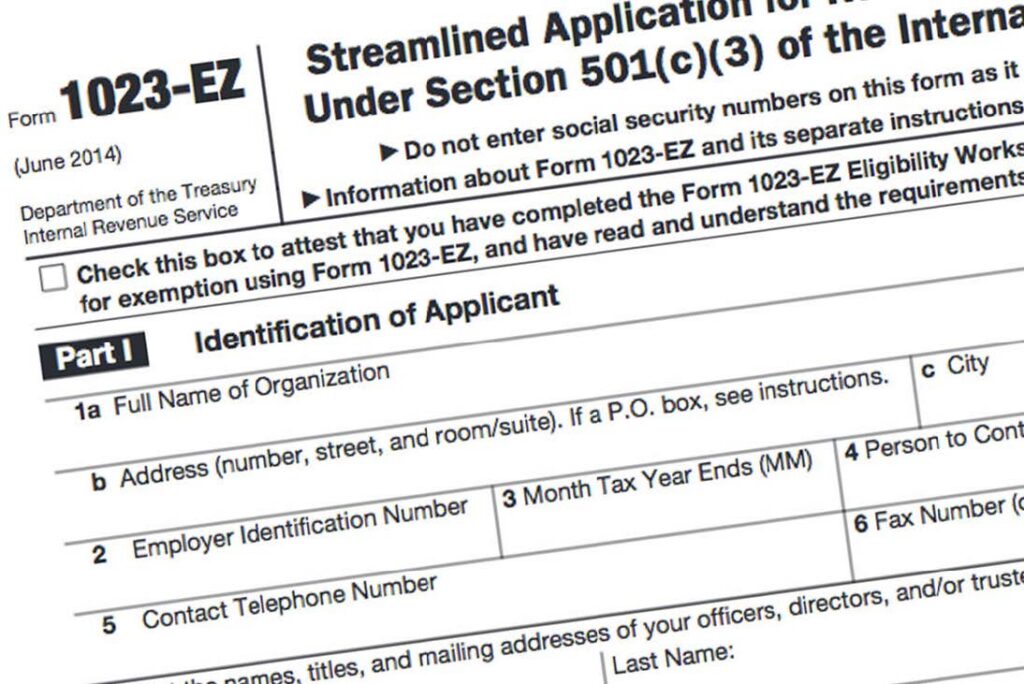
Incorporating does not make an organization tax-exempt. Exemption is a federal determination, made by application on Form 1023 or the shorter Form 1023-EZ for smaller organizations. The application asks for governing documents, a narrative of activities, financial projections, and officer compensation, and the quality of those answers determines whether and how quickly exemption is granted.
Exemption comes with conditions: no private inurement, penalty taxes under Section 4958 for transactions that overpay an insider, no political campaign activity, and lobbying that stays insubstantial or within a Section 501(h) election.
Keeping exemption is a matter of filing. Every exempt organization files an annual return, Form 990, 990-EZ, or the 990-N notice depending on revenue, and one that fails to file for three consecutive years loses exemption automatically. Reinstatement is possible but slow. State exemptions are separate: the Nevada Department of Taxation issues a sales and use tax exemption letter to qualifying charitable, religious, and educational organizations under NRS 372.326 and 372.348, which expires after five years and must be renewed, and property tax exemptions run through each county assessor.
Nevada’s Annual Compliance Obligations
Every Chapter 82 corporation files an annual list of officers and directors with the Secretary of State by the last day of its anniversary month. Miss it and the corporation goes into default and then revocation, at which point it cannot lawfully contract, hold property, or receive restricted grants until reinstated.
Organizations that solicit contributions in Nevada must also file a Charitable Solicitation Registration Statement under NRS Chapter 82A, submitted and renewed with the annual list. NRS 82A.110 exempts an organization whose only solicitations in a year go to fewer than 15 people, to relatives of its officers and directors, or to benefit one named individual or family, and exempts qualifying alumni associations, but the exemption must be claimed by filing the Secretary of State’s exemption form. An organization that assumes it is exempt without filing is taking a risk the Attorney General’s office may eventually test.
Two more obligations surprise organizations. A nonprofit that conducts a raffle or other charitable lottery is subject to NRS Chapter 462 and may have to register with the Nevada Gaming Control Board, depending on the value of the prizes. And a nonprofit with employees is an employer for every purpose of Nevada wage and hour, workers’ compensation, and unemployment law, with no charitable exception. The Firm’s Employment & Labor Law and Human Resources Support practices handle those issues, and the line between a volunteer and an employee should be reviewed before the organization relies on it.
Board Duties: What a Director Is Signing Up For
A seat on a Nevada nonprofit board is a legal position. NRS 82.221 requires directors and officers to exercise their powers in good faith and with a view to the interests of the corporation, allows them to rely on financial statements and professional advice unless they know better, and protects them unless it is proved by clear and convincing evidence that they did not act in good faith. NRS 41.480 goes further: no action lies against a nonprofit officer, director, or trustee for failing to exercise due care in managing the organization unless the act involved intentional misconduct, fraud, or a knowing violation of law. NRS 41.485 separately immunizes volunteers for their non-supervisory service, and the federal Volunteer Protection Act provides a parallel shield.
Loyalty is where boards get into trouble. A director who does business with the organization has not necessarily broken the law, but the transaction must be disclosed, approved by the disinterested directors, and shown to be fair. Where it is not, the director faces personal liability, the organization faces an excess benefit problem with the IRS, and the Attorney General can intervene. None of the statutory protections reach a director who diverted assets or knowingly broke the law, and NRS 41.480 makes clear the organization itself remains liable for the negligence of its agents and employees.
Grants, Contracts, and Fiscal Sponsorship
Grant agreements carry spending restrictions, reporting deadlines, and clawback provisions that can turn a well-meaning reallocation into a breach, and a director who signs a contract without authority may bind himself or herself as well. The Firm’s Corporate & Commercial Law attorneys handle these agreements for nonprofits. Fiscal sponsorship, operating a new project under an existing 501(c)(3) rather than incorporating, is often the right answer for a program that needs to start immediately, provided a written agreement addresses who owns the project’s assets and what happens when it wants to stand alone.
When Nonprofits End Up in Court

Nonprofits are sued for the same reasons businesses are, and they also face factional fights over board control, contested elections, and claims that a director diverted assets. The Firm’s Business Law & Commercial Litigation practice litigates these matters or resolves them through mediation, as discussed in the Firm’s article on when it makes sense to mediate a legal dispute. Dissolution is regulated too: remaining assets go to another exempt organization or a government, never to members or directors.
When to Involve a Nonprofit Attorney
Founders who consult counsel at formation typically never think about the structure again; founders who wait meet a nonprofit lawyer when something has gone wrong. A nonprofit attorney in Las Vegas or Reno should be involved when:
- You are forming the organization and want the articles and bylaws to satisfy both NRS Chapter 82 and the IRS on the first filing
- The organization is preparing Form 1023 or has received an IRS request for more information
- A grant, lease, or contract carries obligations the board does not fully understand
- A director, officer, or founder has a financial interest in a proposed transaction
- The Secretary of State has placed the corporation in default, or the IRS has revoked exemption
- Two factions on the board or in the membership disagree about who is in charge
How Hutchison & Steffen Serves Nevada Nonprofits

Hutchison & Steffen is a full-service, AV-rated law firm serving Nevada and the Southwest from offices in Las Vegas and Reno. For three decades the Firm has advised nonprofit organizations on formation, governance, compliance, and litigation, and its attorneys serve as general counsel, board members, and volunteers for charities across the state. The Legal Aid Center of Southern Nevada named Hutchison & Steffen its Pro Bono Law Firm of the Year.
The Firm’s Public Interest & Nonprofit Organizations practice works with its Corporate & Commercial Law, Employment & Labor Law, Real Estate Law, and Business Law & Commercial Litigation attorneys. Founders weighing a for-profit structure instead may find the Firm’s article on Nevada LLC formation useful. You can also review the Firm’s practice areas or meet the attorneys.
Frequently Asked Questions About Nevada Nonprofits
How Do I Start a Nonprofit in Nevada?
File articles of incorporation under NRS Chapter 82 with the Nevada Secretary of State, along with an initial list of officers and directors and a registered agent acceptance. Adopt bylaws and a conflict of interest policy at the first board meeting, obtain an employer identification number, and, if the organization will be a charity, apply for 501(c)(3) recognition on Form 1023 or 1023-EZ. If it will ask the public for donations, file a Charitable Solicitation Registration Statement under NRS Chapter 82A.
Does a Nevada Nonprofit Need a State Business License?
No. Nonprofit corporations formed under NRS Chapter 82 are exempt from the state business license in NRS Chapter 76. They must still file the annual list of officers and directors each year, and organizations that solicit contributions must file the charitable solicitation registration with it.
Can a Nevada Nonprofit Board Member Be Held Personally Liable?
Generally not for good-faith management decisions. NRS 41.480 bars claims against a nonprofit officer, director, or trustee for failing to exercise due care unless the act involved intentional misconduct, fraud, or a knowing violation of law, and NRS 82.221 requires clear and convincing evidence that a director did not act in good faith. Protection is lost for self-dealing and knowing violations, and a director who participates in an excess benefit transaction faces federal penalty taxes personally.
How Does a Nevada Nonprofit Lose Its Tax-Exempt Status?
Most often by failing to file an annual return with the IRS for three consecutive years, which triggers automatic revocation. Exemption can also be revoked for private inurement, substantial lobbying, political campaign activity, or operating outside the exempt purposes. Failing to file the annual list with the Nevada Secretary of State is a separate problem that costs the corporation its good standing.
Can a Nevada Nonprofit Pay Its Founder or Directors?
Yes, within limits. A nonprofit may pay reasonable compensation for services actually rendered, set by disinterested directors using comparable data and documented in the minutes. Compensation above what is reasonable is an excess benefit transaction, subject to penalty taxes on the recipient and on any director who knowingly approved it. Paying a director also removes the separate NRS 41.485 protection for uncompensated volunteer service, though the director-level protection in NRS 41.480 does not depend on compensation.
Contact Hutchison & Steffen About Your Nevada Nonprofit
If you are forming a nonprofit in Nevada, bringing an existing organization into compliance, or facing a governance dispute or a question from the Secretary of State or the IRS, Hutchison & Steffen can help. The Firm represents nonprofit organizations in Las Vegas, Henderson, Summerlin, North Las Vegas, Reno, Sparks, Carson City, and statewide Nevada.
Las Vegas: 702.385.2500 | Reno: 775.853.8746 | hutchlegal.com/contact
Las Vegas: Peccole Professional Park, 10080 W. Alta Drive, Suite 200, Las Vegas, NV 89145. Reno: 100 W. Liberty Street, Suite 765, Reno, NV 89501.
This post is for general informational purposes only and does not constitute legal advice. Prior results do not guarantee a similar outcome. Nonprofit formation and compliance involve state and federal requirements that change over time and depend on the organization’s activities and structure. Consult a qualified Nevada attorney about your specific circumstances.