
Nevada landlord-tenant law lives in two statutes, and property owners who confuse them pay for it. NRS Chapter 118A sets the substantive rules of a residential tenancy: habitability, deposits, entry, rent increases. NRS Chapter 40 governs what happens when the tenancy fails and the owner needs the property back. The expensive mistakes Nevada landlords make tend to happen in Chapter 40, because that chapter is procedural and one defective notice restarts the whole sequence.
This guide covers the notices Nevada law requires, how the eviction process works from first notice through lockout, and the specific points where an owner's position is won or lost. Hutchison & Steffen represents owners, landlords, and property managers in evictions, breach of lease claims, property damage actions, and unlawful detainer proceedings across Clark County, Washoe County, and the rest of the state.
As a full-service, AV-rated law firm with nearly 60 attorneys serving Nevada and the Southwest, Hutchison & Steffen represents owners, landlords, and property managers in evictions and breach of lease claims. If you are dealing with a nonpaying tenant, a holdover, or a contested eviction, call the Las Vegas office at 702.385.2500 or the Reno office at 775.853.8746, or reach the Firm through hutchlegal.com/contact.

The Two Statutes Behind Every Nevada Eviction
Nevada rental laws split the work between two chapters. NRS Chapter 118A is the Residential Landlord and Tenant Act, and it defines the substance of the relationship between owner and occupant. NRS Chapter 40 is the remedies chapter, and it defines unlawful detainer, the notices that precede it, the summary eviction procedure, and the judgment a court can enter.
The practical consequence is that a landlord can be entirely right on the merits under Chapter 118A and still lose in Justice Court because of Chapter 40. Courts do not weigh how badly the tenant behaved against how carelessly the notice was drafted. If the cure period is wrong, or the required advisement is missing, or service was made the wrong way, the notice is void and the owner starts over from day one while the tenant stays in possession.
One more boundary matters. Chapter 118A applies only to residential premises. NRS 118A.180 limits the chapter to a dwelling unit or premises, and NRS 118A.140 defines premises as a dwelling unit and the structure it belongs to. Commercial tenancies are governed by NRS Chapter 118C and a separate summary eviction statute, which the Firm covers in its companion article on commercial lease disputes in Nevada.
Choosing the Right Notice Under NRS Chapter 40
The notice period in a Nevada eviction depends entirely on why the owner is terminating. There is no general-purpose notice. Nevada law prescribes four different tracks with four different clocks, and serving the wrong one is a frequent reason a summary eviction is denied.
Nonpayment of Rent: Seven Judicial Days
Under NRS 40.2512, a residential tenant who fails to pay rent must be given seven judicial days after service before the landlord may proceed. Judicial days exclude Sundays and legal holidays under NRS 1.120 and NRS 1.130, and the day of service does not count. The comparable period is five days for commercial premises and 10 days for a mobile home lot.
This seven-day figure dates to Senate Bill 151, which took effect July 1, 2019. Bad information circulates on this point. Assembly Bill 340 from the 2023 session, which would have restructured these proceedings, was vetoed on June 16, 2023 and never became law. The 2025 legislative session did not amend Chapter 40 at all. Any Nevada landlord still working from a five-day pay-or-quit template has been out of compliance for seven years.
One related trap sits in NRS 40.253(11). A landlord may not refuse rent tendered after the notice on the ground that the tenant has not also paid collection costs or attorney fees. Late charges and dishonored check charges are the exception. Refusing a proper tender because the tenant did not pay everything the ledger shows will hand the tenant a defense.
Breach of a Lease Covenant Other Than Rent: Five Days to Cure
NRS 40.2516 governs a breach of lease that does not involve rent, such as an unauthorized occupant, a pet in violation of the agreement, or a prohibited alteration. The notice must be in the alternative: perform the covenant or surrender the premises. The tenant then has five days to cure, and any subtenant, mortgagee of the term, or other interested party may cure within the same window and save the lease from forfeiture.
The statute contains a provision most owners overlook. If the violated covenant cannot afterward be performed, no notice need be given. A tenant who has already caused irreversible harm is not entitled to a cure period for something that can no longer be cured. That determination is fact-specific and should be made with counsel rather than assumed, because getting it wrong forfeits the notice.
Waste, Nuisance, and Unlawful Use: Three Days, No Cure
NRS 40.2514 provides a three-day notice to surrender with no opportunity to cure. It applies when a tenant assigns or sublets contrary to the lease, commits or permits waste, carries on an unlawful business on the premises, maintains a nuisance, or violates Nevada's controlled substance statutes other than NRS 453.336.
Nuisance is defined in the statute as conduct or an ongoing condition that unreasonably obstructs the free use of the property and causes injury and damage to other tenants or occupants. That definition matters: complaints from neighboring units, documented in writing and dated, are what turn a nuisance allegation into a provable one.
No-Cause Termination of a Periodic Tenancy
NRS 40.251 allows an owner to end a periodic tenancy without cause. The notice is at least seven days for a week-to-week tenancy, at least 30 days for any other periodic tenancy, and at least five days for a tenancy at will. A separate five-day track applies where the tenant has failed to perform basic or contractual obligations under Chapter 118A.
NRS 40.251(5) requires the notice to include a statement advising the tenant of the extension rights described below. The advisement is part of the required content. A 30-day no-cause notice that omits it is defective on its face, and the owner will learn that at the hearing rather than before it.
The Extension Request for Older Tenants and Tenants With Disabilities
Nevada does not automatically give older tenants a 60-day notice, which is a persistent misconception. Under NRS 40.251(2), a tenant who is 60 years of age or older or who has a physical or mental disability may request an additional 30 days beyond the period in the notice, and the tenant must make that request in writing with proof of age or disability. Where the request is granted on a month-to-month tenancy, the result is 30 days plus 30 days.
If the landlord rejects the request, the tenant may petition the court under NRS 40.251(6). Even if the court denies the tenant's petition, the tenant still receives five calendar days after entry of the order. The extension does not apply to the shorter five-day notice for failure to perform obligations under Chapter 118A.

Service of the Notice Under NRS 40.280
Under NRS 40.280, a Nevada landlord may not personally serve the notices required by NRS 40.251 through NRS 40.260. Service must be made by the sheriff, a constable, a person licensed as a process server under NRS Chapter 648, or the agent of an attorney licensed to practice in Nevada. An owner or property manager who tapes the notice to the door themselves has not effected service, and the defect is fatal.
The statute permits three methods: personal delivery to the tenant; leaving a copy with a person of suitable age and discretion at the residence or place of business and mailing a copy; or, if no such person can be found, posting the notice conspicuously on the property, delivering a copy to any resident present, and mailing a copy to the tenant.
Proof of service must be filed with the court before the court may issue an order to remove or a writ of restitution. The proof consists of the server's written statement showing the date, the manner of service, and the server's badge or license number. Where an attorney's agent served the notice, a signed declaration from the attorney is required, and NRS 40.280(7) permits an attorney's agent to serve only at the direction and under the direct supervision of the attorney retained in the action.
For owners managing multiple units, service is worth standardizing. A standing relationship with a licensed process server and a fixed template for the proof of service remove a common source of defective notices well before a hearing.
How the Nevada Eviction Process Actually Works
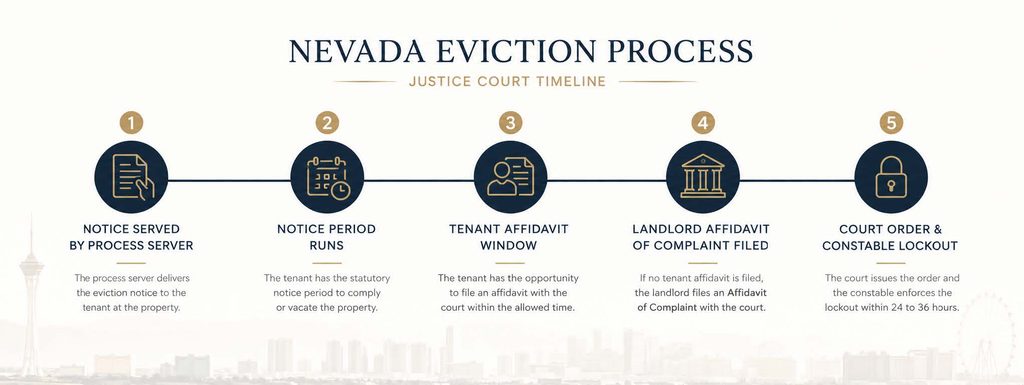
Nevada's summary eviction process is unusual in that the tenant, not the landlord, files first. After the notice period runs, the tenant may file an affidavit with the court contesting the eviction. If the tenant does not, the landlord applies by affidavit of complaint for eviction to the Justice Court. This structure, set out in NRS 40.253 for nonpayment and NRS 40.254 for other grounds, is unchanged by the 2023 and 2025 sessions.
The landlord's affidavit under NRS 40.253(5) must state nine specific items: when the tenancy began, the periodic rent, any deposits in excess of the first month's rent, the date the rent became delinquent, how long the tenant has remained in possession without paying, the amount claimed due, a statement of service under NRS 40.280, a copy of the notice, and a copy of the rental agreement if one exists. An affidavit missing an element is a continuance at best.
There is a second notice most owners do not expect. For grounds other than nonpayment, NRS 40.254 requires a written notice to surrender that advises the tenant of the right to contest by filing an affidavit before the court's close of business on the fifth judicial day after service. Justice courts publish this as the five-day notice to quit for unlawful detainer. It is served after the underlying notice expires and before the landlord files. It is not a post-judgment notice, and treating it as one collapses the timeline.
If both parties file affidavits, the court holds a hearing. Under NRS 40.253(6), if the tenant establishes a legal defense, the court refuses to grant either party relief and the matter moves to a formal action under NRS 40.290 through NRS 40.420. That is a materially slower and more expensive path, which is why the quality of the notice and the completeness of the file matter so much at the front end.
Once the court enters an eviction order, the sheriff or constable posts it on the premises no later than 24 hours after receiving it, and removes the tenant not earlier than 24 hours and not later than 36 hours after that posting. In Las Vegas Township, the constable requires an Instructions to Constable form and a lockout fee in addition to the Justice Court filing fee.
Where a Nevada Eviction Is Filed: Township, Not County
Nevada evictions are filed in the Justice Court of the township where the property sits, not the county. NRS 40.253(5)(a) is explicit on this point, and it catches owners who assume Clark County means Las Vegas Justice Court. Clark County has 11 justice court townships, including Henderson, North Las Vegas, Boulder City, Laughlin, Mesquite, and Moapa Valley. Washoe County includes Reno, Sparks, and Incline Village and Crystal Bay.
A rental in Henderson is filed in Henderson Justice Court. A rental in North Las Vegas is filed in North Las Vegas Justice Court. Filing in the wrong township wastes the filing fee and, more importantly, the notice period that preceded it.
Jurisdiction is limited by amount. Under NRS 4.370, justice courts hear actions for possession where the relation of landlord and tenant exists when damages claimed do not exceed $15,000 or when no damages are claimed. An owner pursuing substantial unpaid rent and property damage above that threshold is looking at District Court, and the strategy question of whether to split possession from damages should be decided before anything is filed.
What a Nevada Court Can Award Beyond Possession
Possession is not the only remedy. Under NRS 40.360(2), the trier of fact assesses the damages occasioned by any forcible entry or forcible or unlawful detainer, along with any amount found due for waste, and the judgment is entered for the rent and for three times the amount of the damages assessed. Read that carefully: Nevada trebles the damages and awards the rent separately. It does not treble the rent.
NRS 40.360(3) provides a redemption window. Where the proceeding is for unlawful detainer after a rent default and the lease has not expired by its terms, execution on the judgment is stayed for five days after entry, during which the tenant, a subtenant, a mortgagee of the term, or another interested party may pay the judgment and costs into court and be restored to possession. In all other cases the judgment may be enforced immediately.
Security deposit exposure runs on a separate track under NRS 118A.242. The deposit ceiling is three months' periodic rent, and the last month's rent counts toward that cap. Within 30 days of the end of the tenancy the landlord must return the balance and provide an itemized written accounting. Missing that deadline makes the owner liable for the entire deposit plus a further sum fixed by the court up to the amount of the deposit, which is why move-in and move-out condition documentation is worth the time it takes.
What Changed for Nevada Landlords in 2025
The 2025 Legislature left the eviction statutes alone but rewrote how Nevada landlords disclose and collect money. Assembly Bill 121, effective October 1, 2025, requires periodic rent to be stated as a single figure representing the maximum total amount of rent including any mandatory fees, and prohibits charging periodic rent above that disclosed figure.
The same act requires a landlord to offer at least one rent payment method that costs the tenant nothing and does not require bank account information, caps online portal fees at the operator's actual cost with separate identification in the lease, requires a copy of the form rental agreement on a prospective tenant's request, requires refund of application, credit report, and background check fees where the unit was rented to someone else and the screening was never run, and bars those fees for household members under 18.
Two other 2025 measures touch operations. Senate Bill 201, effective July 1, 2025, addresses a tenant's right to display religious or cultural items. Senate Bill 114 adds a written key policy and background check requirements for employees with key access under NRS 118A.332. Owners should have their lease forms, fee schedules, and application processes reviewed against these changes rather than assuming last year's template still complies.

When to Bring in a Nevada Eviction Attorney
A Nevada eviction becomes a matter for counsel when the tenant contests it, when the money at stake exceeds what a justice court can award, or when the tenancy falls outside the residential summary process. Many routine matters can be handled with a clean lease, a properly served notice, and good records. An eviction lawyer in Las Vegas or Reno is worth involving when:
- The tenant has filed an affidavit contesting the eviction, or has raised a habitability, retaliation, or fair housing defense
- Unpaid rent and property damage together exceed the $15,000 justice court threshold
- The tenancy is commercial, where NRS Chapter 118C and NRS 40.2542 apply instead of the residential track
- The tenant has appealed a summary eviction order to District Court
- You are revising lease templates, fee schedules, or application procedures for a portfolio and need them to hold up under Chapter 118A as amended in 2025
- There is a guaranty, an assignment, or a sublease complicating who is actually liable
Appeals deserve a note of their own. A summary eviction order is appealed to District Court, with the notice of appeal due within 10 judicial days of entry, and a tenant seeking to stay the eviction must move to set bond. In a formal unlawful detainer action, NRS 40.380 gives either party 10 days to appeal, and a defendant's appeal does not stay execution unless the defendant files an undertaking of not less than twice the amount of the judgment and costs. Those are different tracks with different numbers, and they should not be blended.
How Hutchison & Steffen Represents Nevada Property Owners
Hutchison & Steffen is a full-service, AV-rated law firm serving Nevada and the Southwest from offices in Las Vegas and Reno. For nearly three decades, the Firm has represented owners, landlords, and property managers in evictions, lease disputes, property damage claims, and unlawful detainer actions throughout Clark County, Washoe County, and statewide. The Firm's Landlord/Tenant practice works the owner's side of these matters, from drafting the notice through the constable lockout and any appeal that follows.
Because ownership disputes rarely stay in one lane, the Firm also handles Nevada real estate matters, construction and construction defect litigation, and business and commercial litigation for the entities that hold the property. Owners whose portfolio includes retail, office, or industrial space should read the companion piece on commercial lease disputes in Nevada, and owners weighing a damages claim for unpaid rent will find the framework in breach of contract lawsuits in Nevada. Those structuring or restructuring how they hold title may also find the Firm's article on Nevada LLC formation and asset protection useful, and those weighing a negotiated resolution over a contested hearing can review when it makes sense to mediate a legal dispute. You can also review the Firm's full range of practice areas or meet the attorneys who handle these cases.
Frequently Asked Questions About Nevada Landlord-Tenant Law
How Many Days Is a Pay-or-Quit Notice in Nevada?
Seven judicial days for residential property, under NRS 40.2512. Judicial days exclude Sundays and legal holidays, and the day of service does not count. The period is five days for commercial premises and 10 days for a mobile home lot. The five-day residential figure that still circulates online has been wrong since July 1, 2019.
Can a Nevada Landlord Serve an Eviction Notice Themselves?
No. NRS 40.280 requires the notices under NRS 40.251 through NRS 40.260 to be served by a sheriff, a constable, a licensed process server, or the agent of a Nevada-licensed attorney. A notice posted by the owner or the property manager has not been served, and proof of service must be filed with the court before an order to remove can issue.
How Long Does the Eviction Process Take in Nevada?
An uncontested summary eviction for nonpayment commonly runs three to five weeks from service of the notice to the constable lockout, depending on the township's calendar. If the tenant files an affidavit and establishes a legal defense, the court refuses relief under NRS 40.253(6) and the matter moves to a formal action under NRS 40.290 through NRS 40.420, which takes months rather than weeks.
Do Tenants Over 60 Automatically Get 60 Days' Notice in Nevada?
No. Under NRS 40.251(2), a tenant who is 60 or older or who has a physical or mental disability may request an additional 30 days by submitting a written request with proof. It is a request, not an automatic entitlement. The landlord's no-cause notice must advise the tenant of that right under NRS 40.251(5), and a notice that omits the advisement is defective.
What Court Hears Evictions in Las Vegas and Reno?
The Justice Court of the township where the property is located. That is Las Vegas Justice Court for the Las Vegas Township and Reno Justice Court for the Reno Township, but Henderson, North Las Vegas, Sparks, and several other townships have their own justice courts. Justice court jurisdiction over landlord-tenant possession actions is capped at $15,000 in damages under NRS 4.370, or unlimited where no damages are claimed.

Contact Hutchison & Steffen About a Nevada Eviction or Lease Dispute
If you are a Nevada property owner facing a nonpaying tenant, a holdover, a contested summary eviction, or a lease dispute that has outgrown a notice, Hutchison & Steffen can evaluate your position and handle the matter from notice through judgment. Backed by the experience of nearly 60 attorneys and deep Nevada roots, the Firm represents landlords and property managers in Las Vegas, Henderson, Summerlin, North Las Vegas, Reno, Sparks, Carson City, and statewide Nevada.
Las Vegas: 702.385.2500 | Reno: 775.853.8746 | hutchlegal.com/contact
Las Vegas: Peccole Professional Park, 10080 W. Alta Drive, Suite 200, Las Vegas, NV 89145. Reno: 100 W. Liberty Street, Suite 765, Reno, NV 89501.
This post is for general informational purposes only and does not constitute legal advice. Prior results do not guarantee a similar outcome. Nevada landlord-tenant law involves strict deadlines and procedures that vary based on the property, the lease terms, and the township in which the property is located. Consult a qualified Nevada attorney about your specific circumstances.