THERE WAS ONE THING gnawing at the three adult children of David "Jim" Judelson, former president of Gulf & Western, following their mother's death: Why was their dad spending so much time with Eva Gayer?
They knew Eva as their 82-year-old dad's private banker, a woman with an Eastern European lilt, an affinity for Van Cleef & Arpels jewelry and a husband, Jonas. Sometimes the Gayers would bump into the Judelsons during the family's Sunday night meals at Gino's on Manhattan's Upper East Side. On a couple of occasions, the Gayers had attended an art opening at a Chelsea gallery owned by the Judelsons' oldest, Paul.
Jim and Eva were friendly, yes, the kids thought. But they weren't that close.
In the months following their mother's February 2011 death, however, Eva, 17 years their father's junior, became his ever-present companion. In that time, Jim, long a careful, conservative spender who favored staid, tailored suits, started wearing flashy Armani attire and occasionally a fedora befitting of a Prohibition-era gangster. He traded in his Volvo of 20 years for a luxury Audi sedan. Despite Eva's own marriage, she and Jim developed an intimate relationship.
Over time, Eva began to hold what looked to the children like unusual influence over their father, including controlling access to him and sending them emails that she said he dictated to her. Eva frequently took Jim to the home she and her husband shared on Shelter Island, a wealthy Long Island enclave about three hours from his loved ones in Manhattan.
"Eva worked on my father for years and years," another son, Roy Judelson, would later say of his father's turn against his kids and "even his grandchildren, whom he had adored and had spent countless time with in pre Eva days." The presence of Jonas Gayer as a third wheel in their relationship unsettled the Judelson children. A Russian émigré who wore fedoras as well, Jonas worked as a tax consultant and had past run-ins with the law.
By 2014, Jim was referring to still-married Eva as his life partner, waving away his children's concerns about the Gayers and his declining memory. The next year, the children said Eva pressured Jim to make them sign a document agreeing not to contest the millions of dollars in gifts he had given her and planned to provide her.
When they objected, Roy said that he remembers Eva pronouncing that "If you won't sign the agreement, I'll just have to marry your father," which she denies. Jim died in 2018 at 89, two weeks after hitting his head in a fall. At the time of his death, he was married to Eva, who had made good on her alleged threat, divorcing her husband in 2015 and weeks later tying the knot with Jim in a small ceremony without his family present.
Was this a case of elder abuse?
Experts frequently warn against total strangers targeting seniors through online scams. But what happens when seniors fall victim to friends, family members and associates who form close relationships late in life?
Elder-abusers will isolate victims in order to control their finances, experts say, and cases can be difficult to prosecute. The number of such cases is expected to sharply rise over the next decades as baby boomers and members of the silent generation, who own nearly two thirds of the nation's wealth, age and prepare to transfer their money to the next generation.
But deciphering the inner workings of a relationship is complicated. Was Jim Judelson a victim? Or were the Judelson children spoiled grown-ups in denial that their dad had fallen in love with someone new?
These questions sparked a six-year court battle between the Judelson kids and their new stepmother. According to the children, their father's marriage was a sham, part of an elaborate grift by the Gayers to take advantage of him as he showed signs of depression, Alzheimer's and Parkinson's. "Even the most successful among us, including those who have reached the highest levels of success and achievement during their prime," Roy Judelson says in a statement, "can succumb to elder abuse from predators who take advantage of them in their later years."
To Eva, who denied manipulating Jim, their father simply grew tired of supporting his adult children, whom she said he had given $46 million in gifts, investments and loans over the course of his life, amounts that they dispute. These rich kids had finally been cut off, she said, and were using her as a scapegoat.
This story is based on a review of thousands of pages of court filings, transcripts, emails, two self-published books by Jim and more than a dozen interviews with his associates, people with knowledge of the legal fight and lawyers. Eva and Jonas didn't respond to requests for comment. Her lawyer declined to comment.
"I knew that his children would view me as 'competition,'" Eva said of their battle in a court filing, "and make life difficult for both of us."
"SHE WAS MY very best friend and the love of my life," Jim wrote of his first wife, Maria, in 2011. Over their 57-year marriage, he wrote in a letter to friends announcing her death, they traveled the world, walked the streets of New York and watched the sunset on the pier of their lake house. "Through it all, however, the most important thing to Maria," he wrote, "was spending time together with her family."
The son of a machine factory owner, Jim grew up in Brooklyn and New Jersey, eventually attending New York University to study engineering. He met Maria on the beach on Fire Island on a Labor Day weekend, and they married a year later in 1953. The couple had three children-Paul, Jeaneane and Roy-who wanted for nothing thanks to Jim's success at the conglomerate Gulf & Western.
Jim played a key role in the conglomerate's founding, after befriending Charles Bluhdorn, a mercurial Austrian immigrant whom he met while on vacation at Lake Champlain. Bluhdorn encouraged Jim to join him in buying shares of a Michigan car-bumper manufacturer. That led to the acquisition of auto-part distributors, then natural-resource companies and eventually entertainment businesses, including, famously, Paramount Studios.
By the 1980s, the two executives were focused on different parts of the Gulf & Western empire. Jim was known as the dry, straight-shooting executive who oversaw the operations side of the businesses and championed innovative ideas like electric vehicles. (The concept, two decades too early, didn't gain support within the company.) Charlie was the chairman and gravitated toward the glamorous world of Paramount and its film stars.
The two men had been close but drifted apart over time. Jim would remain president and chief operating officer until Bluhdorn died in 1983 and had hoped to succeed his onetime friend-but ultimately he didn't have the backing of the board. After he was passed over, he took his $9 million pay package and quit. (Decades later, Barry Diller, who was then on the Gulf & Western board, bemoaned backing Jim's rival in the succession fight.)
At Gulf & Western, Jim jet-setted around the world, but back at home he tried to keep his children grounded. Their 13-room Manhattan apartment was decorated with Tiffany lamps, Russian bronze works and oil paintings. In the evenings, Maria played classical music on her Steinway; in the summer, they went to their house on Lake Hopatcong in New Jersey, a location close enough for Jim to reach on weeknights after work. Even as the Judelson kids became adults, the family met for Sunday night dinner at a local Italian restaurant. Jim's grandchildren called him Papa and regularly slept over at their home.
Business deals also became a family affair. Jim invested more than $5.4 million in a Chelsea art gallery for Paul and helped him purchase a townhouse not far from Jim and Maria. Later in life, the older son helped out his dad, getting a gallery client to invest $18 million in two cash-hungry companies Jim held major stakes in. Jim's daughter, Jeaneane, moved to Chicago after getting married and became a social worker. Her husband ran a tech company largely funded by Jim.
Then there was their younger son, Roy, a former college tennis star who briefly played professionally on the European circuit and inherited Jim's passion for striking deals. After studying business at the University of Arizona, Roy became an executive at sports and media company IMG before taking an entrepreneurial turn leading startups.
From the late 1980s into the 2000s, Roy and his dad partnered on investing in Manhattan properties, with Jim making $11 million in profit. Jim also put more than $11 million into a software company that Roy operated but was later dissolved. The father contributed another $8.4 million toward Roy's $10.5 million apartment as a place where Roy planned to raise his own family. Whether Jim's money was a gift or investment later became a bone of contention in the estate fight.
Jim had been more than a doting parent; he had kept his children afloat, Eva said in court filings. According to her calculations, he provided
Roy with a total of $25 million in loans, gifts and investments, while Paul got $14 million and Jeaneane received $7 million. The kids dispute that the numbers were that high.
"Jim's relationship with his children was complicated to say the least," said Eva's lawyer in a court filing. "None of them were able to stand on their own and support themselves."
EVA GAYER, meanwhile, didn't come from wealth. Born in postwar Poland in 1946, Eva grew up in a country with limited economic opportunities, so in her early 20s, she headed to the U.S. In 1967. she married Jonas Gayer, a Soviet émigré who was in college studying economics. She took classes at a community college, then earned a business degree at New York University before making it to Wall Street. He was an accountant who worked for the Internal Revenue Service and later for a private firm. They had one daughter and lived in a tree-lined neighborhood in Queens. By the late 1980s the family had made it.
"Eva is my wife and I want to have the freedom to leave her what I want"
— JIM JUDELSON IN AN EMAIL TO HIS YOUNGER SON
Then came 1989.
Jonas was one of five people charged in a scheme to help the principal of a Brooklyn trucking company evade paying $10 million in personal income taxes, interest and penalties. The arrest cost him his job and led to near financial ruin. He pleaded guilty to a misdemeanor charge for filing a false tax form with the IRS.
Months after Jonas was charged, Evablonde, beautiful and in her mid-40s-walked into Jim's office in the Seagram Building. At the time, she was vice president of private banking at National Westminster Bank and was trying to recruit him as a client. Jim was still flush with cash, and by the late 1980s, his net worth had swelled to over $100 million, according to a person familiar with his finances.
He agreed to put $1 million into accounts at Eva's bank, and from there a relationship blossomed. That same year, the Gayers sold their Queens home and moved to a place in Manhattan-just a 12-minute walk south of Jim and Maria's home.
Soon the two families were entwined. Jim sent birthday cards to Eva's daughter and attended her wedding in 2003 with Maria. Jim and Maria even went on dinner dates with Eva and Jonas.
Sometimes Eva would bring Jim along to meet her prospective banking clients. When she became a vice president at Signature Bank, his money followed. In the 2000s, she briefly oversaw an account for Roy, who said the relationships were strictly professional. His parents never socialized with the Gayers, he would later say, and if they happened to be at the same restaurant, it was by coincidence or orchestrated by Eva.
Over the next two decades, Eva acquired expensive tastes. She was on a first-name basis with the manager of the Van Cleef & Arpels jewelry store on Fifth Avenue and attended its special events, according to court filings.
Jonas was once again thriving with a tax-consulting business. In his spare time, he painted pictures of boats and cars at his Shelter Island retreat. He popped up in gossip pages for escorting Jocelyn Wildenstein, a socialite the tabloids nicknamed "The Catwoman," to the 2000 opening of a Midtown Manhattan eatery.
Occasionally Jonas's work led to legal entanglements. In two separate civil cases, he was subpoenaed or deposed for information about former clients who were accused of hiding money or assets.
But it wasn't until 2012, when his name showed up as the moneyman behind a notorious high-end prostitution ring run by a woman the city's tabloids dubbed the "Soccer Mom Madam" that the Judelson kids felt that something was really off. Gayer pleaded guilty to a felony charge of promoting prostitution and was sentenced to five years of probation. Jim's sons sat their father down to warn him-and at first their father was surprised by the guilty plea, then grew silent. But the shock didn't last. "I am perfectly capable of making my own decisions about how I wish to spend my remaining years, and I have chosen to spend them largely with Eva," Jim wrote in a sharply worded letter to his children after they continued to raise concerns. Although Eva was still married to Jonas, Jim was clear: "I want Eva treated as my life partner and respected as the person with whom I share my home."
IN EARLY 2015, an investigator with the Manhattan district attorney's office showed up at Jim's door to interview him after a complaint that Jim was being abused had been made by someone close to him. Investigators need to find proof that an alleged victim lacks capacity to consent to giving away money. They also need to confirm the alleged fraudster was aware of the victim's mental state. Jim, now 86, had been showing signs of decline. He was taking medication to treat dementia and told his doctor that his memory was getting progressively worse. His personal assistant had also told the doctor that Jim had difficulty managing his finances and executing simple tasks like signing a check. Jim had sold the apartment that he had lived in with Maria for $13 million and moved into a much smaller unit in the same building.
At one point, a housekeeper had noticed bruises on Jim's face, shoulders and chest after a weekend trip with the Gayers in Shelter Island. At the time, Eva said Jonas, who was still her husband, had gotten physical when Jim came into their room in the middle of the night to sleep with her, the housekeeper later recounted in a court filing. (Eva denied the allegations in court papers, saying her husband had battled cancer and suffered a stroke and would have been too weak to attack Jim.)
At around this time, Jim asked his children to sign an agreement that they wouldn't contest any gifts that Jim gave Eva while he was alive or after he was dead. All three rejected the proposal, which prompted Eva to say that she would divorce Jonas and marry their father to get what she wanted, according to Roy. Eva denies the retort.
Jim felt humiliated by the district attorney's investigation and suspected one of his children had betrayed him, Eva later said in an affidavit. "He recognized that they were only interested in his money," she said, "not his happiness." The office closed the probe without any charges. To this day, no one in the family admits to knowing who made the complaint.
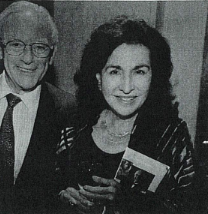
Maria and Jim Judelson were married for over 57 years before she died in 2011. "Through it all," he wrote, "the most important thing to Maria was spending time together with her family."
SOON EVA AND JONAS officially divorced. Three weeks later, on September 11, 2015, Jim and Eva married on Shelter Island-without his children present. Lavish purchases soon followed. The couple spent about $1 million on luxury baubles such as Cartier jewelry, Sotheby's lots and cashmere shawls and sweaters from Loro Piana. Another $1 million covered expenses for Eva's family, including a half-million on her grandson and his education at a Manhattan prep school. Hundreds of thousands of dollars went to the refurbishment of the Shelter Island home that she still shared with Jonas. There were also hundreds of thousands of dollars in checks from Jim's accounts written out to "cash" or to himself.
There were other red flags, the children said: Eva controlled what Jim ate (no onions), and she controlled the schedule for when his kids and grandkids could visit (at times, they'd been turned away by doormen). Once, Roy said, when he took his dad to lunch without Eva on Christmas Eve, she accused him of kidnapping his father.
Jim sometimes grew annoyed with Roy, especially in February 2016, when he believed his son tried to stop him from bequeathing Eva shares in the software company that he backed and Roy ran. "Eva is my wife and I want to have freedom to leave her what I want," Jim sniped in an email to Roy. "Plus I have given all of you plenty, specially you."
In the end it didn't matter. In 2017, the software company dissolved after running out of funding. Jim was upset, according to Eva. Hе had personally guaranteed to keep the company afloat. Now he was on the hook to pay back the company's $2 million bank loan.
JIM DIED on September 17, 2018. At first the three children presented a united front when Eva filed a will, one month later, that named herself and Jim's lawyer as executors of the estate. According to the will, Jim gave her a significant share of whatever money and assets he had left. Jim had changed his will 13 times between 2014 and 2017, and his children suspected Eva was to blame. They also accused Eva of squandering as much as $30 million of their father's money before he died. At this point, there was not much money left in his estate.
But as ugly as the immediate aftermath of Jim's death was, it got worse. In June 2019, Jeaneane started to question Roy's motives.
At issue was a 70% ownership of Roy's apartment, which was worth $9.25 million at the time. When Jim was alive, he had made Roy sign an agreement acknowledging Jim's stake in the home, and required Roy to hand over nearly $7 million to the estate to be divided among the beneficiaries of his will.
Now, amid the fight, Roy was refusing to pony up on principle. He had the funds to pay the estate but said the money to buy the apartment had been a gift. He said Eva forced his father to ask him to sign the agreement under duress, and that Roy conceded at the time because he was himself under duress from battling cancer.
Jeaneane was taken aback. If Roy didn't pay back the estate, that meant less of an inheritance for her. She also feared Roy and Eva would strike a side deal that only benefited themselves, Jeaneane told the court. So she hired her own lawyer and asked the court to be represented independently of her siblings.
"He is clearly pursuing his own interests and his interests alone," Jeaneane said of Roy in a court filing. "My brother was a grown man by the time the apartment was purchased, and my father, generous as he was, would not have made such an extravagant gift," she added, "especially at the expense of any inheritance due to his other two children." Jeaneane declined to comment for this article.
And so the legal battle went on for five more years-through the Covid pandemic, through high school and college graduations, a time during which Jeaneane and Roy had grown estranged, and finally through a shocking allegation that would challenge everything they'd known about their father.
"FOR EVA MY DEAREST DEAR,
It is year twenty two since I first met you
And slowly a bond grew
That must be known to few"
Jim wrote this in a letter on October 3, 2011, a few months after Maria died. It was an important anniversary: the day he and Eva had met back in1989.
Eva submitted this letter as a court exhibit more than two years after the legal feud between her and her stepchildren began. She also shared effusive love poems that she said Jim had sent her on Valentine's Day, Christmas and her birthday. An avid watch collector, Jim had given Eva one of his cherished timepieces on her 60th birthday in 2006. "I cannot think of a more appropriate way to demonstrate how much you have meant and mean to me," he wrote in a note. According to property records, he even gave her a one-bedroom Manhattan apartment in 2004.
Eva included more than a dozen of his love notes in the exhibit that she said showed their affair had gone on since they met.
Estate cases can be a reckoning for families, dredging up uncomfortable truths and serving as a reminder that relationships aren't always what they seem. Over a year after his first wife's death, Jim had confessed to his family that he and Eva had a secret romance while their mother was alive, but until Eva filed her trove of letters from Jim, they hadn't known the extent of the relationship.
In 2024, exhaustion over the fighting and mounting legal fees prompted all sides to lay down their swords and reach a settlement, approved this past October.
Under the deal, Roy agreed to pay $3.25 million to his dad's estate and will receive some mementos from his mother including her Steinway. Jeaneane gets $1.35 million; and Paul receives just $100,000, having benefited from his father's help in purchasing his home years earlier. Smaller amounts will also go to some of Jim's grandchildren.
Eva, who got to keep the $2.5 million apartment that she lived in with Jim, will receive over $1.8 million under the settlement.
"You," Jim wrote to Eva on Valentine's Day in 2004, on a card doodled with a picture of a stick figure shooting an arrow through a heart, "are the answer to a prayer.