
Coming Soon.
No attorneys found for this practice area.
Trust and probate litigation refers to contested legal proceedings involving the administration, validity, or interpretation of wills, trusts,
and estates. While most estates pass through probate administration without dispute, a meaningful percentage involve conflicts that require resolution in court - contests over a will's validity, disputes about how a trustee has managed assets, or disagreements among
beneficiaries over distributions. The trust and probate litigation definition encompasses both pre-death challenges, such as disputes over a living trust's terms, and post-death matters, such as will contests, executor removal, and fiduciary accountings.
These disputes often involve substantial assets, long standing family relationships, and deeply personal stakes. They can also involve
complex legal questions - the interpretation of decades-old instruments, the application of evolving Nevada statutes, and the intersection of state probate law with federal tax rules.
What is probate litigation, at its core? It is the process by which contested issues in a probate or trust matter are resolved through the
courts. Unlike routine estate administration, which proceeds through relatively standard procedural steps, probate litigation requires trial-level advocacy - pleadings, discovery, motion practice, evidentiary hearings, and often appeals. The same applies to trust litigation and broader fiduciary litigation, which typically unfolds in district court rather than probate court, and which frequently involves breach of fiduciary duty claims, trustee removal, or the modification or termination of a trust.
At Hutchison & Steffen, our Las Vegas probate and trust litigation attorneys bring decades of experience representing both sides of these disputes - fiduciaries defending their actions and beneficiaries challenging them. That dual perspective informs every strategy we build, in Clark County probate court, Nevada district court, and on appeal.
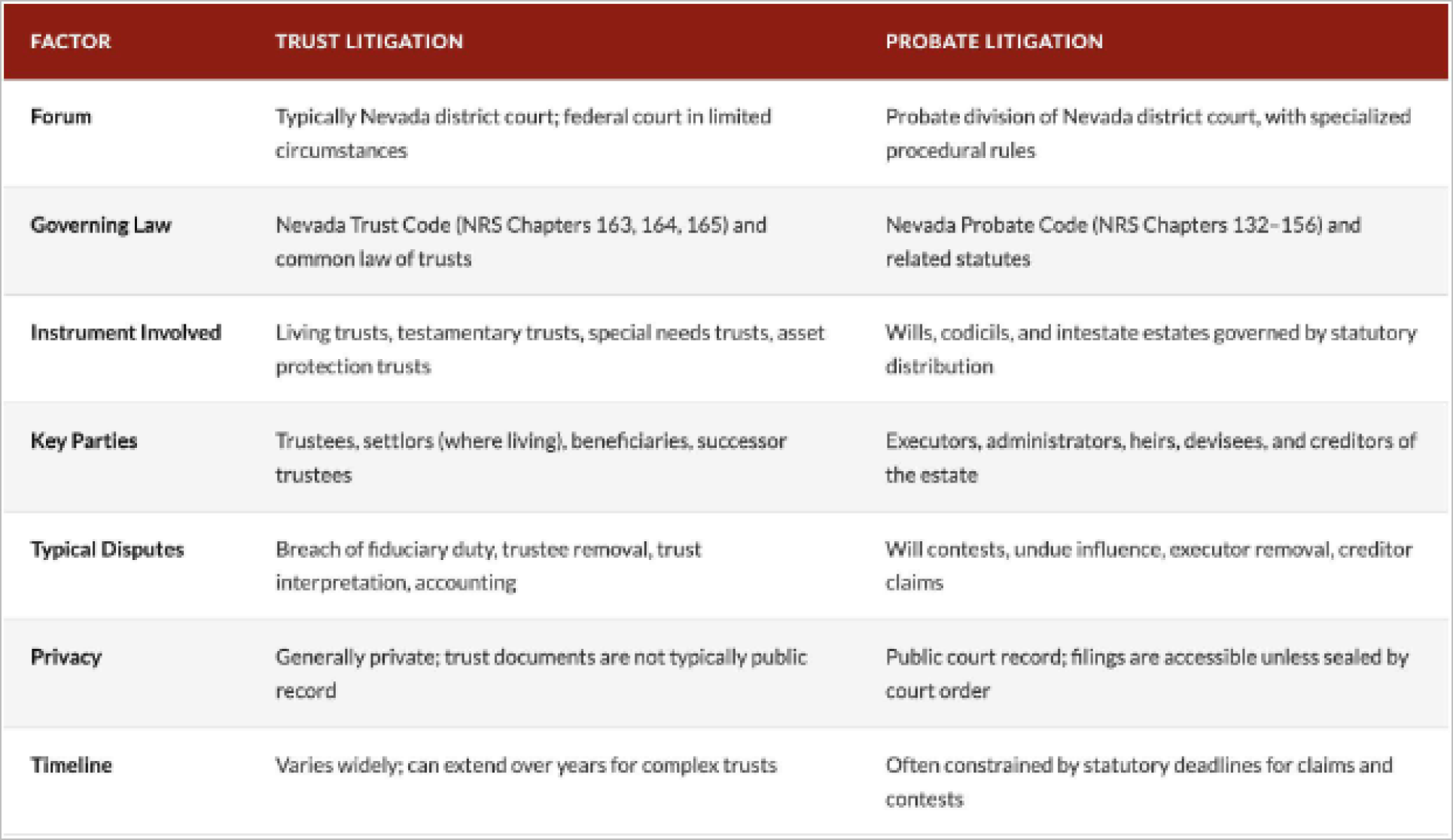
To contest a will in Nevada, an interested person - typically an heir, beneficiary, or prior beneficiary whose interest was reduced or eliminated - must file a formal challenge in the probate court where the will has been admitted or offered for probate. Grounds commonly include undue influence, lack of testamentary capacity, improper execution, fraud, or the existence of a later valid will. The contest is litigated through pleadings, discovery, and often an evidentiary hearing or trial. Because Nevada imposes strict, relatively short deadlines for will contests, anyone considering a challenge should consult a probate litigation attorney quickly.
Only an "Interested person" has standing to contest a will. That generally means an heir who would inherit under Nevada's intestate succession statutes if the will were invalidated, a beneficiary named in an earlier will whose interest was reduced or eliminated, or certain creditors with claims against the estate. A stranger to the estate — or someone whose interest would not be improved by invalidating the will - typically lacks standing. Determining whether a particular person qualifies as an interested person is often the first question our attorneys evaluate.
Nevada imposes strict statutory deadlines for contesting wills and trusts, and they differ depending on the type of instrument and whether certain statutory notices have been provided. In probate matters, the deadline may be as short as three months from a specific procedural event. For trusts, deadlines can be even shorter where the trustee provides statutory notice to beneficiaries. Because these deadlines are jurisdictional and often unforgiving, any suspected basis to contest should be evaluated by an attorney promptly.
A breach of fiduciary duty occurs when a trustee acts contrary to the duties of loyalty, care, impartiality, or prudent administration that Nevada law imposes on all trustees. Common examples include self-dealing (using trust property for personal benefit), commingling trust assets with personal assets, making distributions outside the terms of the trust, failing to provide required accountings, favoring one beneficiary over another without justification, and imprudent investment of trust property. Breach of fiduciary duty claims can support remedies including surcharge, removal, and in some cases punitive damages.
Undue influence refers to conduct that overcomes a testator's or settlor's free will - typically by a person in a position of trust or authority who exploits that relationship to secure a favorable inheritance. Evidence of undue influence often includes an unusual or sudden change in an estate plan, isolation of the decedent from family or prior advisors, heavy involvement by the benefitting party in the drafting process, and a significant disparity between prior and current dispositions. Nevada courts consider these factors collectively rather than in isolation.
Yes. Under Nevada law, a trustee can be removed by court order for a range of reasons - serious breach of trust, unfitness or incapacity, persistent failure to administer the trust effectively, or in some cases when all qualified beneficiarles request removal and the court finds it consistent with a material purpose of the trust. Trustee removal is typically sought through a petition in Nevada district court, often alongside claims for accounting or surcharge. The process requires careful documentation of the grounds and an understanding of both the trust instrument and the governing statute.
Many trust and probate disputes settle - often through mediation or negotiated family settlement agreements - before reaching trial. Others do not. Whether your matter proceeds to trial depends on the strength of the positions, the willingness of the parties to compromise, and the nature of the relief sought. Our attorneys prepare every matter as if it will be tried, which positions our clients favorably in settlement negotiations and ensures we are ready if the case does go before a judge.