
Coming Soon.
No attorneys found for this practice area.
Corporate law poverns the formation, operation, and dissolution of business entities. Commercial law governs the transactions those entities enter into. Most business lawyers handle both, because in the real world they overlap constantly - forming an LLC, drafting its
operating agreement, and negotiating its first major vendor contract all happen in the same conversation. The corporate and commercial
law definition covers everything from articles of incorporation and operating agreements to multi-party contracts, joint ventures, and ongoing govemance counseling.
Though often discussed together, corporate law and commercial law emphasize slightly different concerns. Corporate law focuses on the internal structure and governance of the entity itself - sharcholders, directors, officers, fiduciary duties, and the legal mechanics of ownership. Commercial law focuses on the external relationships a business has - contracts, sales, financing, licensing, and the rights and obligations between the business and third parties.
Nevada is widely regarded as one of the most business-friendly jurisdictions in the United States, with a mature body of corporate law
codified in NRS Chapters 76 and B6, strong statutory protections for directors and officers, and no state corporate income tax. These advantages make Nevada an attractive home for closely held companies, holding structures, and operating businesses - and they are why business owners from across the country choose to form a Nevada LLC or Nevada corporation.
At Hutchison & Steffen, our Las Vegas business lawyers and corporate attorneys advise Nevada companies from formation through sale or succession - handling the legal work that protects the enterprise and supporting the decisions that move it forward.
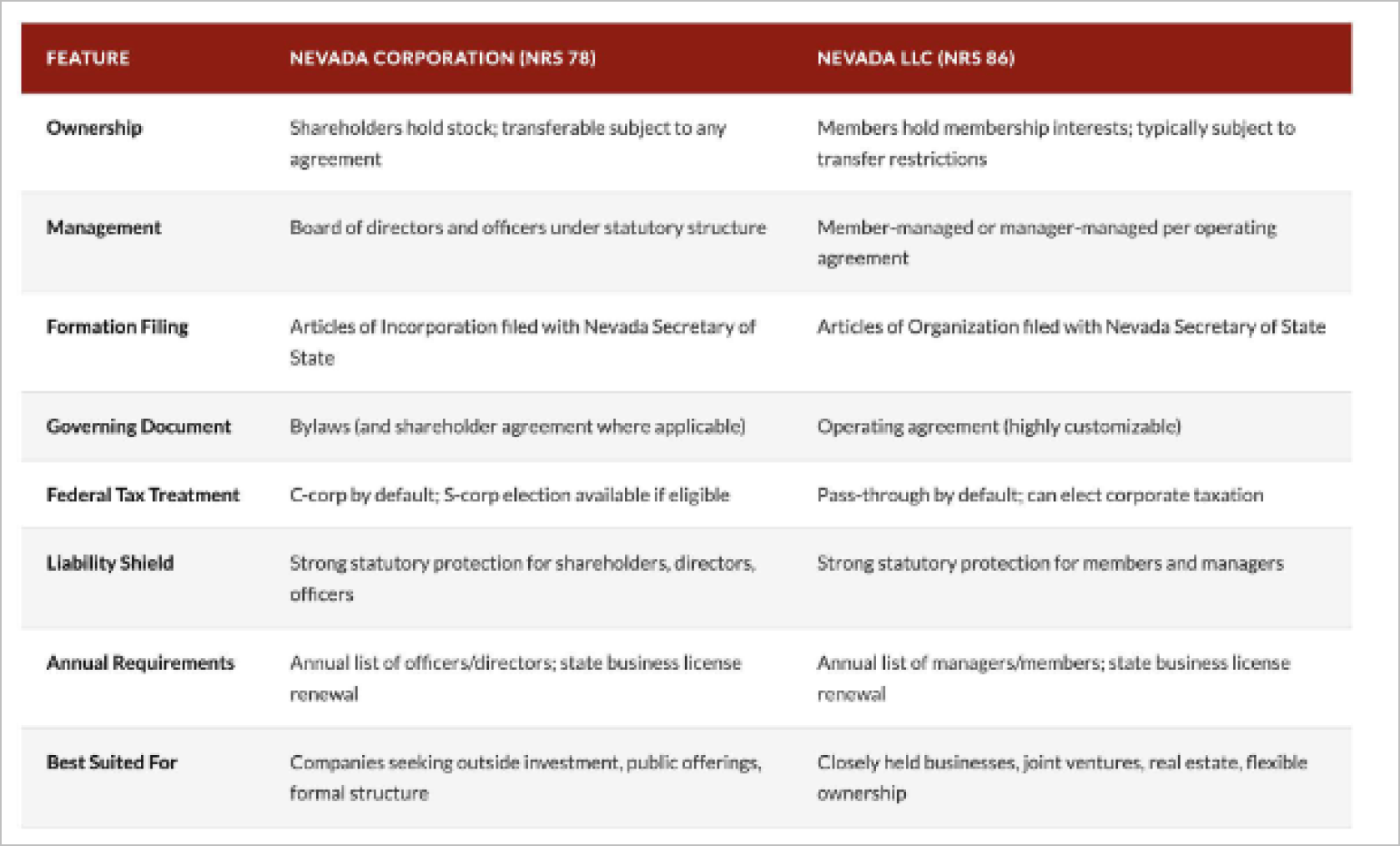
Corporate law is the body of law governing the formation, operation, governance, and dissolution of business entities such as corporations and limited liability companies, It covers the relationships among the entity and its owners, directors, officers, and third parties - including fiduciary duties, shareholder rights, voting, mergers, and the statutory framework under which the entity exists. In Nevada, corporate law is codified primarily in NR Chapters 78 (corporations) and B6 (LLCs), and it is shaped further by case law and the governing documents each entity adopts.
Corporate law focuses on the internal structure, governance, and ownership of business entities — shareholders, directors, officers, fiduciary duties, and the statutes that govern how a company is formed and operated. Commercial law focuses on the external transactions a business enters into - contracts, sales, financing, and relationships with vendors, customers, and other third parties. Most corporate and commercial practices handle both, as they overlap constantly in real-world business matters. A single transaction — for example, a business sale — often involves both corporate law questions (ownership transfer, board approvals) and commercial law questions (purchase agreements, assignment of contracts).
The right entity depends on factors that include ownership structure, tax planning, anticipated outside investment, and how the business will be managed. Nevada LLCs ofter pass-through taxation by default and highly flexible governance through the operating agreement, making them a common choice for closely held businesses, real estate holdings, and joint ventures. Nevada corporations offer a more formal governance structure, are better suited for businesses seeking outside equity investment, and allow for 5-corp election under appropriate circumstances. Our attomeys counsel clients on LLC vs. corporation selection based on the specific goals and facts off each situation.
Forming a Nevada LLC requires filing Articles of Organization with the Nevada Secretary of State, designating a Nevada registered agent with a physical in- state address, paying the initial filing fee and state business license fee, and submitting the initial list of managers or members. The operating agreement - which eoverns how the LLC Is managed and how ownership Interests work - Is not filed with the state but is essential for any LLC with more than one member and strongly recommended for single-member LLOs as well. Our attorneys handle every step of Nevada ULC formation and draft operating agreements tailored to each client's situation.
Nevada is widely regarded as one of the most business-friendly jurisdictions in the United States. The state has a well-developed body of corporate law INRS Chapters 78 and 86], strong statutory protections for directors and officers, no state corporate income tax, no personal income tax, and a reputation for efficient and business-oriented courts. These features attract a mix of operating businesses, closely held companies, and holding structures. That said, Nevada incorporation is not always the right answer — especially for businesses that operate primarily in another state — and our attorneys advise clients on whether Nevada formation actually delivers the benefits they are seeking.
Yes. Nevada law requires every corporation, LLC, limited partnership, and similar entity to maintain a registered agent — sometimes called a resident agent - with a physical Nevada address to accept service of process and official correspondence from the Secretary of State. Hutchison & Steffen serves as Nevada registered agent for business clients and handles the related annual filings, including the annual list of officers, directors, managers, or members, and state business license renewals, so that entities remain in good standing.
Shareholder and member disputes are often best resolved without litigation. Our shareholder dispute attorneys begin by evaluating the governing documents - the shareholder agreement, operating agreement, bylaws, or partnership agreement — and the legal rights of each party. From there, we explore negotlated resolutions, including buyouts, governance changes, or dispute-resolution mechanisms already built into the governing instruments. Where negotiation is insufficient, the Firm has extensive litigation experience and can pursue or defend claims in court. Our goal is always to resolve disputes in a way that protects the business and our client's ownership interest.