
Coming Soon.
No attorneys found for this practice area.
Appellate litigation is the specialized practice of challenging or defending decisions made by trial courts, administrative agencies, and
arbitration panels in higher courts of review. Unlike trial litigation - where facts are contested, witnesses are examined, and evidence is admitted - appellate practice centers on written briefs and oral argument, requiring attorneys to persuade judges that legal errors warrant a different outcome.
An appellate litigator's work is fundamentally different from that of a trial lawyer. Appellate courts do not retry cases; they review the
record to determine whether the law was correctly applied. Success at the appellate level depends on the ability to identify reversible legal
error, frame compelling arguments within a precise written brief, and present those arguments persuasively before a panel of judges who have already read the record in full.
Appellate courts also shape the law going forward. Decisions issued by the Nevada Supreme Court, the Ninth Circuit, or the U.S. Supreme Court establish binding precedent that governs future cases. This makes appellate litigation not just a matter of winning or losing a single dispute — it is participation in the ongoing development of the law itself.
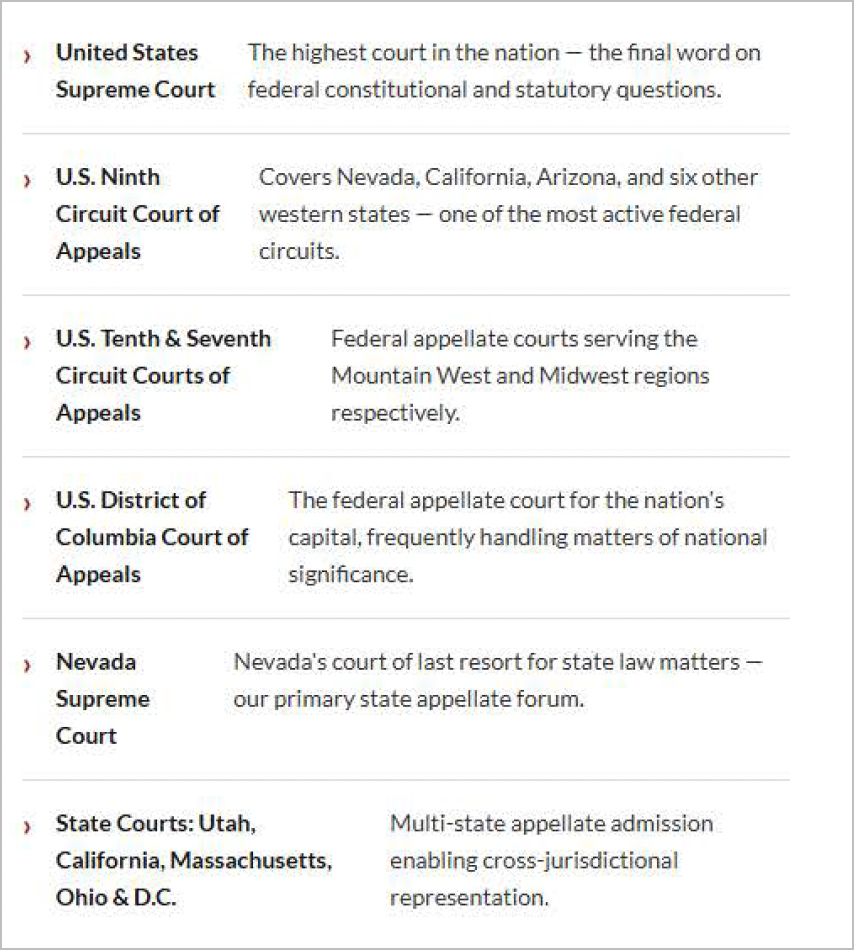
Courts Where Our Appellate Litigators Are Admitted
Trial litigation involves the presentation of facts, evidence, and witness testimony to a judge or jury to resolve a dispute at the initial level. Appellate litigation occurs after a trial court or agency has issued a decision — it involves reviewing the record to identify legal errors and presenting written and oral arguments to a higher court. Appellate courts do not hear new evidence or retry the case; they review whether the law was correctly applied to the facts already established below.
Ideally, appellate counsel should be involved as early as possible — including before and during trial, to ensure the record is properly preserved for any potential appeal. If a trial has already concluded, time is critical: most jurisdictions impose strict deadlines of 30 days or less for filing a notice of appeal. If you have received an adverse judgment and are considering an appeal, contacting an appellate litigator promptly is essential to protect your options.
Ideally, appellate counsel should be involved as early as possible — including before and during trial, to ensure the record is properly preserved for any potential appeal. If a trial has already concluded, time is critical: most jurisdictions impose strict deadlines of 30 days or less for filing a notice of appeal. If you have received an adverse judgment and are considering an appeal, contacting an appellate litigator promptly is essential to protect your options.
Litigation and dispute resolution at the appellate level refers to the full spectrum of post-trial legal activity - from appealing a final judgment to seeking writs, challenging administrative agency decisions in court, and pursuing emergency interlocutory relief. It also encompasses strategic decisions made during litigation to preserve issues for potential appeal. Hutchison & Steffen handles both the trial-level strategy and the appellate proceedings that follow.
Our appellate litigators are admitted to the U.S. Supreme Court, the U.S. Ninth, Tenth, Seventh, and D.C. Circuit Courts of Appeals, the Nevada Supreme Court, and state appellate courts in Nevada, Utah, California, Massachusetts, Ohio, and the District of Columbia. Several of our attorneys have also served as law clerks to federal circuit court judges and Nevada Supreme Court justices - experience that provides a uniquely informed perspective on appellate advocacy.
An amicus curiae ("friend of the court") brief is filed by a party that is not directly involved in a case but has a significant interest in the outcome or the legal precedent it will establish. Amicus briefs are common in high-profile appellate matters, particularly at the state supreme court and federal circuit level. Hutchison & Steffen prepares amicus briefs for organizations, industry groups, and government entities with a stake in the legal issues being decided.