
Pillar: Alternative Dispute Resolution

Overview

Coming Soon.

Practice Area Attorneys

No attorneys found for this practice area.
Understanding The Practice

What is Alternative Dispute Resolution?

Alternative dispute resolution - commonly abbreviated as ADR -
refers to any structured process used to resolve a legal dispute without proceeding to a full courtroom trial. The alternative dispute resolution definition, broadly stated, encompasses methods such as
mediation, arbitration, negotiation, and neutral evaluation, all designed to reach a binding or agreed-upon resolution more efficiently than traditional litigation.

The full form of ADR is "alternative dispute resolution," a term that has grown in use across virtually every area of civil and commercial law. ADR is not a single process but a family of approaches - each suited to different types of disputes, relationships, and desired outcomes. Understanding which method fits your situation is often the first and most consequential step in resolving a dispute effectively.

What is dispute resolution, at its core? It is the process by which parties in conflict reach a conclusion - whether through agreement, a neutral decision, or a court judgment. ADR distinguishes itself from litigation by offering more flexible, private, and often faster paths to that conclusion, while preserving the parties' ability to influence both the process and the outcome.

At Hutchison & Steffen, our ADR attorneys bring a perspective few firms can match: we represent clients in mediation and arbitration proceedings, and our attorneys also serve independently as mediators and arbitrators. That firsthand experience on both sides of the process gives our clients a meaningful strategic advantage in every ADR matter we handle.

METHODS OF ADR

Types of Alternative Dispute Resolution

Mediation
A neutral mediator facilitates structured dialogue between disputing parties to help them reach a voluntary, mutually acceptable settlement. Mediation is non- binding unless an agreement is reached and signed - making it one of the most flexible and collaborative forms of disputes resolution available. It is especially effective when preserving an ongoing relationship matters.
Arbitration
One or more neutral arbitrators hear
evidence and legal arguments from both sides and issue a binding decision. Arbitration is typically faster and less formal than litigation and is widely used in commercial contracts and employment agreements. Many proceedings are administered through judicial arbitration and mediation services providers such as JAMS or the American Arbitration Association.
Negotiation
Direct negotiation - with skilled legal counsel advocating on your behalf — is
often the fastest and least costly path to resolution. Our attorneys are experienced negotiators who understand when to press hard and when a well-structured settlement better protects a client's long- term interests.
Early Neutral Evaluation
A neutral expert provides a non-binding assessment of each side's legal position early in the dispute. This process aligns expectations, sharpens strategy, and frequently catalyzes settlement discussions before significant costs accumulate on either side.
External Dispute Resolution
External dispute resolution (EDR) refers to any formal process administered by an independent third-party organization outside the disputing parties - such as JAMS, the AAA, or a government-established body. The external dispute resolution meaning is distinct from informal internal procedures; EDR is governed by the rules of the administering organization and is often specified by contract.
ADR at Contract Formation
Hutchison & Steffen advises clients at the time of contract formation on how to structure dispute resolution clauses - selecting the right method, governing rules, and procedural safeguards before a dispute ever arises. Weil-drafted contract
 anguage can significantly reduce the cost and complexity of resolving future disagreements.

Making the Right Choice

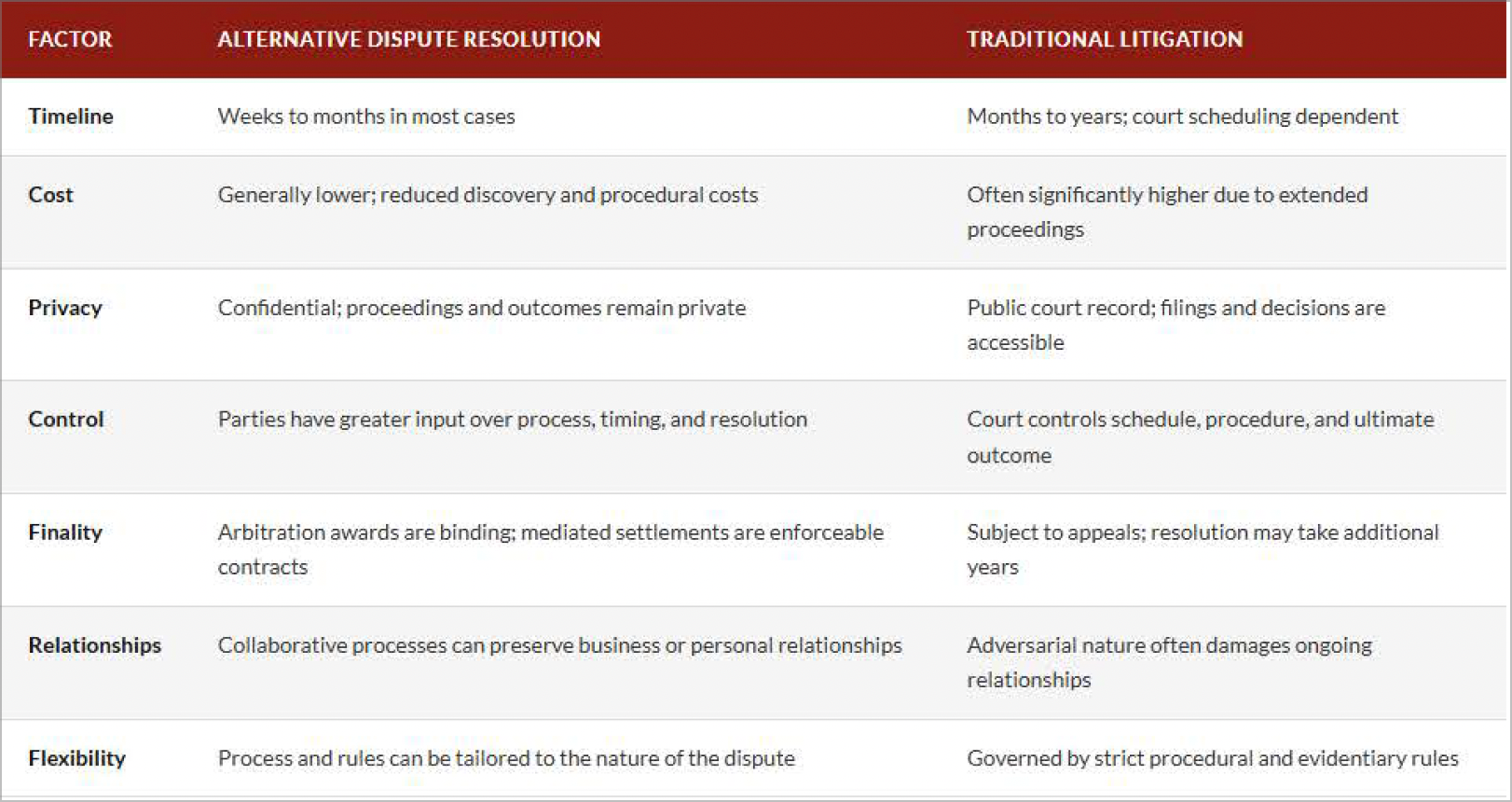
ADR vs. Traditional Litigation

Not every dispute belongs in a courtroom. Understanding the key differences between ADR and litigation helps clients choose the path most likely to produce the outcome they need.

IS ADR RIGHT FOR YOUR DISPUTE?

IS ADR RIGHT FOR YOUR DISPUTE?

ADR is not a universal solution, but it is well-suited to a wide range of civil and commercial disputes. Our attorneys help clients assess whether their situation is a strong candidate for resolution outside of court - and which method is most likely to succeed given the parties, the stakes, and the relationship involved.

ADR is particularly effective when parties have an ongoing relationship they wish to preserve, when confidentiality is a priority, or when a faster resolution would meaningfully reduce business disruption. It is also the right choice when parties want more control over the outcome than a courtroom verdict allows.

Our attorneys are also experienced in cases where ADR is contractually required. Many commercial agreements, employment contracts, and consumer contracts include mandatory mediation or arbitration clauses - Hutchison & Steffen is well-positioned to represent clients both in navigating those clauses and in challenging them where appropriate.

ADR Is Commonly Used In:

Commercial and business contract disputes
Construction and contractor disagreements
Employment and workplace conflicts
Medical malpractice and personal injury matters
Real estate and property disputes
Partnership and shareholder disagreements
Insurance coverage and claims disputes
Professional liability matters
Franchise and licensing disagreements
Disputes subject to mandatory arbitration clauses

Common Questions

Frequently Asked Questions

What is the difference between mediation and arbitration?

Mediation is a voluntary, facilitated negotiation in which a neutral mediator helps parties work toward a mutually agreed settlement - the mediator does not impose a decision. If no agreement is reached, the parties may still proceed to arbitration or litigation. Arbitration, by contrast, is an adjudicative process in which a neutral arbitrator hears evidence and issues a binding decision, much like a private judge. Both are forms of alternative dispute resolution, but they differ significantly in process, finality, and the degree of party control over the outcome.

What is external dispute resolution (EDR)?

External dispute resolution refers to any formal resolution process administered by an independent third-party organization - such as JAMS, the American Arbitration Association, or a government-established body. The external dispute resolution meaning is distinct from informal internal procedures, such as a company's internal grievance process. EDR is governed by the rules of the administering organization and is frequently designated in commercial contracts as the required method for resolving future disputes.

Do I need an attorney for mediation or arbitration?

While representation is not always legally required in ADR proceedings, having experienced counsel is strongly advisable — particularly in complex commercial, construction, employment, or high-stakes disputes. In arbitration, the hearing functions like a trial: evidence is presented, witnesses are examined, and legal arguments are made before a neutral decision-maker. In mediation, skilled negotiation can significantly affect the terms of any settlement reached. Our attorneys ensure your rights are protected and your position is presented as effectively as possible throughout the process.

What if my contract requires arbitration?

Many commercial contracts, employment agreements, and consumer agreements include mandatory arbitration clauses that require disputes to be resolved through arbitration rather than in court. If such a clause applies to your matter, our attorneys can guide you through the arbitration process, clarify the applicable rules, and advocate effectively on your behalf. In some circumstances, mandatory arbitration clauses can also be challenged — our attorneys can assess whether that is a viable option in your specific situation.

Can Hutchison & Steffen serve as neutral mediators or arbitrators?

Yes. Separately from client representation, Hutchison & Steffen attorneys serve as mediators and arbitrators in matters that do not involve the Firm's clients. The Firm is routinely engaged to provide neutral dispute resolution services in commercial, construction, medical malpractice, personal injury, and employment disputes. This dual capacity - as both advocate and neutral - gives our attorneys an unusually comprehensive perspective on the ADR process and what it takes to succeed within it.

Are arbitration awards and mediated settlements legally enforceable?

Yes. Binding arbitration awards are enforceable in court under both federal and Nevada law - they can be confirmed as court judgments and collected in the same manner as any other court-ordered remedy. Mediated settlement agreements, once signed by the parties, are enforceable contracts. If a party fails to honor a mediated settlement, the other party may seek court enforcement of the agreement.

chevron-down
linkedin facebook pinterest youtube rss twitter instagram facebook-blank rss-blank linkedin-blank pinterest youtube twitter instagram