

When co-owners of a Nevada limited liability company stop agreeing, one question comes up almost immediately: how to remove a member from an LLC. The answer depends far more on your operating agreement than most owners expect, because Nevada law gives LLC members strong protection against being forced out. This article explains what NRS Chapter 86 actually allows, the paths available when your operating agreement covers removal, and the options that remain when it does not.
If you are dealing with a member dispute right now, the business law and commercial litigation attorneys at Hutchison & Steffen have handled these matters for Nevada companies for 30 years. Call 702.385.2500 in Las Vegas or 775.853.8746 in Reno to discuss your situation.
The Short Answer: Your Operating Agreement Controls
In Nevada, you can remove a member from an LLC only if the operating agreement gives you that power or the member agrees to leave. NRS Chapter 86 contains no default provision that lets a majority expel a member, so an LLC with a silent operating agreement generally cannot force a member out by vote. When removal is not available, the practical alternatives are a negotiated buyout, a structured separation of the business, or, in serious cases, dissolution of the company itself.
That framework surprises many owners. Nevada is one of the most popular states in the country for forming LLCs, in part because its statutes defer heavily to the members’ private contract. That deference cuts both ways. It gives well-drafted companies enormous flexibility, and it leaves poorly documented companies with very few tools when a relationship breaks down.
What NRS Chapter 86 Says About Members and Their Rights
NRS Chapter 86 governs every Nevada limited liability company. Under NRS 86.286, members may adopt an operating agreement to govern the company’s affairs, and Nevada courts treat that agreement as a binding contract among the members. The statute supplies default rules only where the agreement is silent.
Two features of the Nevada framework matter most in a member dispute. First, membership interests are property rights. A member owns an economic interest in distributions and, unless the agreement says otherwise, rights to participate in the business. Those rights do not evaporate because the other members are unhappy. Second, the chapter’s dissolution provisions, beginning at NRS 86.491, set out when a Nevada LLC dissolves, including dissolution through the courts. Dissolution is the remedy of last resort, but its availability shapes every buyout negotiation, because both sides know what happens if talks fail.
Start With the Operating Agreement
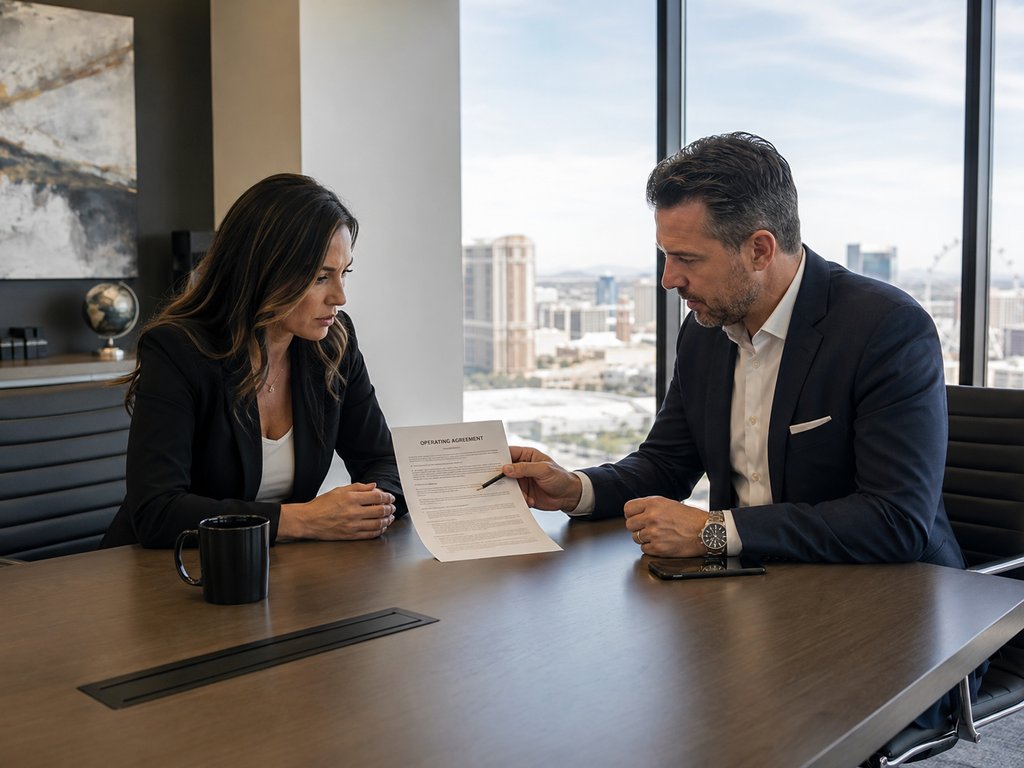
Every Nevada LLC member dispute starts in the same place: the LLC operating agreement. Nevada courts will enforce removal, buyout, and transfer provisions largely as written, so the document’s exact language determines your options. Look for these provisions in particular.
A removal or expulsion clause may allow removal for defined causes such as breach of the agreement, misconduct, felony conviction, or failure to make a required capital contribution. Pay attention to the required vote, the notice the member must receive, and any cure period. Courts expect strict compliance with these procedures, and a removal executed sloppily can be unwound.
A buy-sell provision governs how a departing member’s interest is valued and purchased. Many agreements set an appraisal process, a valuation formula, or a right of first refusal. If your agreement has one, the buyout price fight is usually the real dispute.
A deadlock provision addresses what happens when a company owned in equal halves cannot make decisions. Some agreements use buyout auctions, others mandatory mediation. If yours has one, it likely controls before any court will intervene.
If you are not sure what your agreement permits, have counsel review it before you act. The corporate and commercial law attorneys at Hutchison & Steffen regularly interpret and enforce Nevada operating agreements, and an early read on your contractual position often changes the strategy entirely.
When the Operating Agreement Is Silent
Many Nevada LLCs, especially companies formed online or on an informal basis, such as between friends and family, have no operating agreement or a bare-bones template that never mentions removal. In that situation the default rules of NRS Chapter 86 apply, and those defaults do not include expulsion. Your realistic options narrow to three.
Negotiate a Voluntary Buyout

The most common resolution is a purchase of the departing member’s interest. Even without a buy-sell clause, members can always agree to a sale. The negotiation typically turns on valuation, payment terms, releases of claims, and restrictive covenants. A member who knows removal is unavailable holds the stronger negotiating position, so expect to pay fair value, and get the deal in a written purchase agreement with full releases.
Restructure Around the Dispute
Where a buyout cannot be reached, some companies restructure instead. Depending on the agreement and the votes available, that can mean amending the agreement, changing management structure in a manager-managed company, or dividing lines of business. These moves carry risk. A restructuring designed to squeeze out a member without paying for the interest invites claims for breach of contract and breach of the duties owed among members, so this path requires careful legal guidance.
Dissolve the Company
The last option is dissolution. Members holding the required vote can wind the company up, sell its assets, pay creditors, and distribute what remains. Where the members cannot even agree on that, Nevada law allows a member to ask the district court to order dissolution, most often when the company is deadlocked or it is no longer reasonably practicable to carry on the business. If you are weighing this route and researching how to dissolve an LLC in Nevada, understand that dissolution ends the business for everyone. It is the option that finally forces a resolution, and the credible threat of it is frequently what brings the other side to the table on a buyout.
When a Member Dispute Becomes Litigation
Some disputes cannot be resolved across a conference table. Litigation between LLC members in Nevada typically involves claims for breach of the operating agreement, breach of fiduciary duty by a managing member, misappropriation of company funds or opportunities, and demands for access to books and records. A member being pushed out may also seek a court order protecting their interest while the case proceeds.
These cases move through Nevada’s district courts, and complex matters in Clark County may be assigned to the Business Court, where judges experienced in commercial disputes manage the docket. An experienced business dispute lawyer will evaluate not only the merits but the endgame: whether the realistic outcome is a buyout at a court-influenced price, damages, or dissolution. Hutchison & Steffen’s litigation team handles these disputes from demand letter through trial, and the Firm’s attorneys have tried commercial cases in courts across Nevada. John T. Steffen, the Firm’s co-founder and managing partner, has focused his practice on business and commercial litigation for nearly three decades. The same analysis applies to general partnerships, and a partnership dispute attorney will walk through a parallel set of questions under Nevada’s partnership statutes.
Protecting the Company Before the Next Dispute
Frequently Asked Questions
Can we vote out an LLC member in Nevada without an operating agreement?
Generally, no. NRS Chapter 86 does not give members a default right to expel another member, so without an operating agreement provision authorizing removal, a majority vote will not force a member out. Your realistic options are a negotiated buyout or, in serious deadlock situations, dissolution of the company.
How long does it take to remove a member from a Nevada LLC?
If the operating agreement contains a removal clause, the process can take as little as the notice and cure periods the agreement requires, often 30 to 90 days. If removal requires negotiation or litigation, expect several months to more than a year. Contested member litigation in Nevada district court commonly runs 12 to 24 months if it goes the distance.
Does a removed member still get paid for their interest?
Yes, in almost all cases. Removal ends a member’s management and voting rights, but the economic interest remains their property unless it is purchased. Most operating agreements pair removal with a mandatory buyout at a defined price, and where the agreement is silent, the interest must still be acquired by agreement or addressed in a dissolution.
What is judicial dissolution of a Nevada LLC?
Judicial dissolution is a court-ordered wind-up of the company under Nevada’s LLC dissolution provisions, which begin at NRS 86.491. A district court can order it when members are deadlocked or the business can no longer practicably operate as intended. It is a last resort, but the availability of dissolution often drives the parties toward a negotiated buyout.
Do I need a lawyer for a Nevada LLC member dispute?
For anything beyond a fully amicable separation, yes. The enforceability of a removal, the valuation of an interest, and the duties owed among members are all questions of Nevada law where early missteps are hard to undo. An attorney can also structure the buyout documents so the dispute actually ends rather than resurfacing later.
Talk to a Nevada Business Litigation Team

Hutchison & Steffen is a full-service, AV-rated law firm serving Nevada and the Southwest, with nearly 60 attorneys, 30 years of Nevada practice, and clients across Las Vegas, Henderson, Summerlin, North Las Vegas, Reno, Sparks, Carson City, and statewide.
If an LLC member dispute is threatening your company, call 702.385.2500 in Las Vegas or 775.853.8746 in Reno, or reach the Firm through the contact page.
This article is provided for educational purposes only and is not legal advice. Reading it does not create an attorney-client relationship. Prior results do not guarantee a similar outcome. If you need advice about a specific situation, consult a licensed Nevada attorney.